
Dryer Vent Cleaning: Repair or Replace? How Los Angeles Homeowners Decide
Here’s the straight answer: if your dryer vent is rigid metal and under 25 feet with minimal bends, cleaning is almost always the right call. If it’s white vinyl accordion hose, a crushed section, or a run that snakes 30-plus feet through your walls, you’re looking at repair or replacement. Cleaning a bad vent buys you maybe a year. Replacing it buys you a decade. And here’s the part most people don’t learn until it’s expensive: in Los Angeles, the vent itself is as likely to be the problem as the lint inside it. If you’d rather not spend your Saturday behind the dryer, call (737) 727-2314 and we’ll sort it out.
Why Los Angeles Homes Have Vent Problems Other Cities Don’t
LA housing stock is old. Not charming-old like Boston. More like “the laundry closet was added in 1974 and nobody’s touched it since” old. We work in dryer vent cleaning across Los Angeles, and the same patterns show up in neighborhoods from Van Nuys to Westchester to Highland Park. Long interior walls. Bedrooms stacked above garages. Laundry closets wedged into hallways. Every one of those layouts forces the dryer vent to travel farther and bend more often than it should.
Here’s the code reality most homeowners never hear: the International Residential Code says a dryer exhaust duct can run no more than 25 feet, and every 90-degree elbow eats 5 feet off that limit. A dryer pushed against an exterior wall? Fine, you’re at 2 feet. A dryer in a second-floor hallway closet venting through the roof? You could be at 35 effective feet before you even count the bends. In dense attached housing like duplexes and older condo buildings, these runs routinely exceed code by 10 to 15 feet. The air slows down. Lint drops out and piles up. And suddenly cleaning twice a year isn’t optional hygiene. It’s holding back a design problem.
- Rigid metal ducting: The only material that meets current code in Los Angeles. Smooth interior walls, lint doesn’t catch, and a brush actually cleans it properly.
- Foil accordion hose: Legal at the time, marginal now. Those ridges trap lint like a cheese grater, and the hose sags between joists, creating low spots where moisture and lint collect.
- White vinyl accordion hose: This is the one that should scare you a little. Banned by the International Residential Code since 2002 because it’s a fire accelerant. It melts, it burns, and it’s still inside thousands of LA homes today.
You can identify your vent material without opening a wall. Pull the dryer out six inches and look at what’s behind it. If you see white plastic ribs, plan a replacement this month. If you see silver foil ribs, plan one this year if the run is long or sagging. If you see smooth silver metal with taped seams, you’re in good shape.
The Decision Framework: Clean, Repair, or Replace
Here’s the mental checklist we use when a Los Angeles homeowner asks us to look at their dryer vent. It takes about ten minutes and it removes most of the guesswork.
Clean it if:
- Your vent is rigid metal, runs under 25 feet, and you can see daylight from the outside vent cap when the dryer is running.
- The dryer is against an exterior wall and the vent line is essentially straight.
- You’ve had the home less than three years and the previous owner can’t prove it was ever cleaned.
Repair it if:
- There’s a crushed or kinked section, usually where someone pushed the dryer back too hard against the wall.
- An elbow fitting is loose, disconnected, or pulling apart behind the wall or under the floor.
- You can feel moisture around the duct connection at the dryer, which usually means the seam is leaking warm air into your wall cavity, not outdoors.
Replace it if:
- The vent is white vinyl accordion hose. No exceptions worth making here. It violates code and it will burn if the lint inside it ignites.
- The run exceeds 25 effective feet (length plus elbows) and there’s no practical way to shorten the route.
- Foil or flexible hose is sagging between floors or through a crawlspace, creating a trap where lint and water collect.
We pulled a vinyl vent out of a 1920s Spanish-style duplex over in Echo Park a couple months back. The homeowner had paid another company to clean it twice in two years. The hose was 80 percent blocked both times because the ridges were catching lint as fast as anyone could remove it. They didn’t need cleaning. They needed a rigid metal reroute. About $500 instead of another $129 “cleaning” that fixes nothing. That’s the decision in a nutshell.
What This Actually Costs in Los Angeles
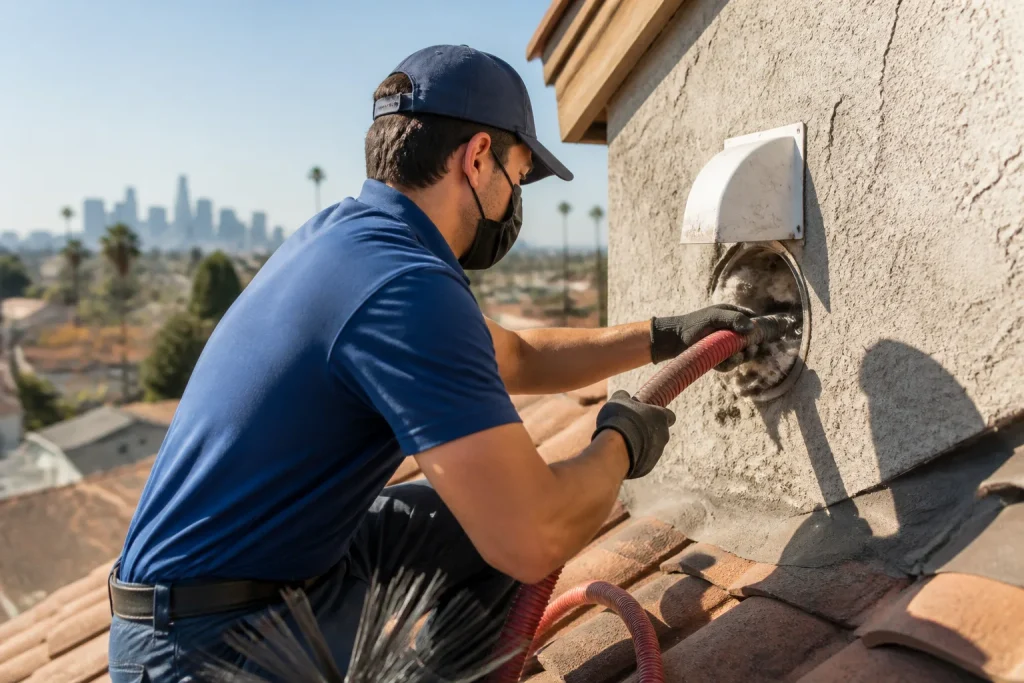
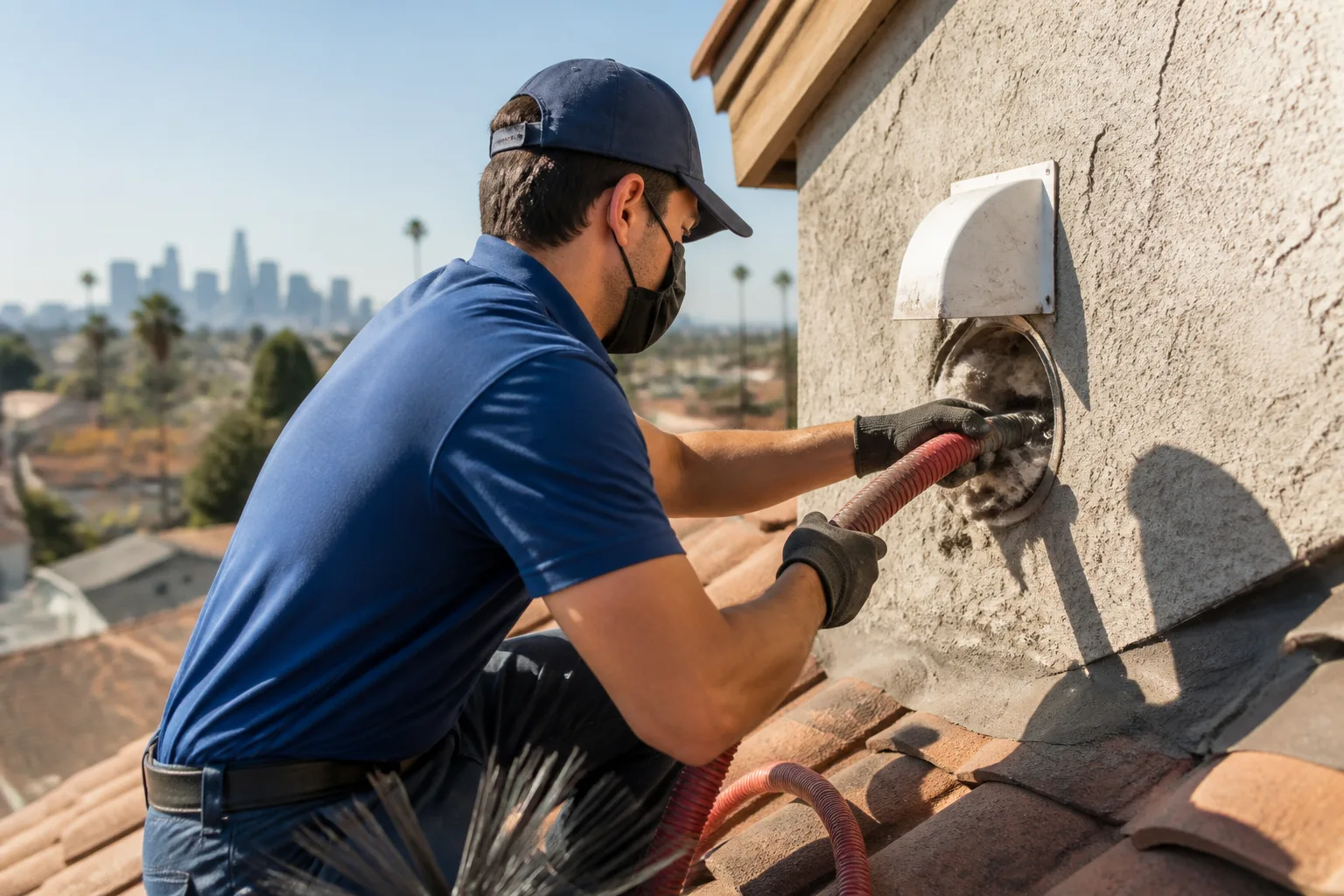
Let’s talk numbers, because vague pricing is how people end up with bad repairs. A standard dryer vent cleaning in Los Angeles, done properly with a rotary brush and HEPA vacuum, runs $89 to $149 for an accessible vent. If the vent is on a roof, add a little for the roof work.
A partial repair, meaning replacing a crushed section or a failed elbow with rigid metal components, runs $150 to $350 depending on how much of the run is affected and whether we need to open drywall to reach it.
A full vent reroute into rigid metal, which is what most older Los Angeles homes need when the existing run is vinyl, severely convoluted, or just too long, typically lands between $400 and $800. That includes the new rigid ducting, the vent cap, sealing, and testing the airflow before we leave. Four hundred to eight hundred dollars is real money. But shoot that against a fire claim and it stops being a debate. The National Fire Protection Association reports that failure to clean dryer vents is the leading cause of dryer fires, and dryers start roughly 13,000 house fires a year. A vent fire inside a wall cavity spreads before your smoke detector even notices. The $400 repair stops looking expensive.
One thing to watch for: companies that quote a low per-vent price and then “discover” problems after the work starts. That’s the bait-and-switch pattern in this trade. We hand you a written price before any work begins, and that price does not change at the door. Ever. If we find a crushed section mid-cleaning, we stop, show you photos, and you decide. You see the condition before you approve anything.
How Los Angeles Duplexes and Condos Change the Math
Attached housing creates a problem most single-family homeowners never face: shared walls mean the shortest vent path often isn’t available. In a duplex with laundry closets back-to-back, both dryers might vent through a shared interior chase that runs 30 feet to the roof. In a condo tower, your dryer vent might join a common stack before it exits the building. In a hillside townhome, you might vent horizontally under the floor for 20 feet before reaching exterior air.
These long, convoluted runs are exactly where cleaning repeatedly becomes a losing strategy. The vent isn’t dirty because you’re lazy. It’s dirty because the air doesn’t move fast enough to carry lint out. Total visibility matters at this decision point. When we clean a vent, you get before-and-after photos of the actual duct interior, so you’re not taking anybody’s word for it. If the photos show a vent that’s not just dirty but structurally wrong, that’s the moment to talk repair or replacement rather than schedule another cleaning for six months out. You can also see the same visual problem coming with regular maintenance on the air duct side of the system.
What Cleaning Can Fix (and What It Can’t)
Cleaning does one thing: it removes the obstruction inside an otherwise functional duct. When your vent is rigid metal, properly sloped, and code-compliant in length, cleaning restores full airflow and dries your clothes faster. We use a Rotobrush rotary brush system paired with a Nikro HEPA-filtered vacuum. The brush spins through the duct and loosens lint; the vacuum pulls it out under negative pressure, which means the debris goes into the vacuum, not back into your laundry room. Trust us, you don’t want to breathe what comes out of a five-year-old dryer vent.
What cleaning cannot do is fix a design or material problem. It won’t make vinyl hose safe. It won’t straighten a crushed section. It won’t shorten a 35-foot run. It won’t re-slope a sagging foil hose that’s collecting water in a low spot. If you’re paying for cleaning twice a year and your dryer still takes two cycles to dry a load of towels, the vent itself is telling you something.
When to Call a Pro (and What to Look For)
Dryer vent work is not a casual DIY project. The vent carries warm, damp, lint-filled air, and if you do the repair wrong, you’re creating a hidden fire hazard rather than fixing one. Reaching into a wall to reconnect a duct, running rigid metal through joists, sealing seams properly so they don’t leak into the wall cavity – this is skilled work, and the stakes are real.
If you’re in Los Angeles and you’re not sure what material your vent is or whether your run meets code, call someone who will tell you the truth and show you the evidence. Look for a company that gives you a written price before work starts, shows before-and-after photos, and stands behind the work. Our Done Right Promise means exactly what it sounds like: if the work isn’t right within a full year, we come back and make it right at no charge. That applies to every single job, no fine print, no exceptions. If you need a broader system check, our HVAC cleaning service in Los Angeles covers the ductwork beyond the dryer line. And if you want to start with the big picture on your home’s air system, visit the Cardinal Air Duct Cleaning home page to see how the three services fit together.
The Bottom Line
Most dryer vent problems in Los Angeles are mechanical, not hygienic. If your vent is rigid metal and reasonably short, clean it annually and you’re done. If it’s vinyl, crushed, sagging, or too long, no amount of cleaning will make it safe or efficient. The peace you want isn’t a receipt for another cleaning. It’s knowing the duct itself is right. If you’re in Los Angeles and need a straight answer, Cardinal Air Duct Cleaning offers free estimates. Call (737) 727-2314 and we’ll tell you what you actually need, not what’s easiest to sell you.
Frequently Asked Questions
A cleaning will remove lint from the vinyl hose, but the hose itself remains a fire hazard and violates the International Residential Code that’s been in force since 2002. The only real fix is replacing the vinyl with rigid metal ducting, which usually runs $400 to $800 in Los Angeles. Call (737) 727-2314 for a written estimate on replacement rather than paying to clean material that should come out.
If the vent is rigid metal, under 25 effective feet (length plus elbows), and you can see the flapper on the outside vent cap moving when the dryer runs, cleaning is likely all you need. If the vent is crushed, disconnected at a seam, sagging, made of vinyl or foil hose, or the run exceeds 25 feet, it needs repair or replacement. We show you before-and-after photos on every job so you can see the condition yourself before deciding.
A standard dryer vent cleaning in Los Angeles runs $89 to $149 for an accessible vent, with a little more if roof access is required. Repair work on a crushed section or failed elbow runs $150 to $350, and a full rigid metal reroute for a code-compliant vent runs $400 to $800. We give you a written price before any work starts, and that price doesn’t change when the technician arrives.
Cheap quotes usually mean a technician with a shop vac and a brush, skipping the HEPA extraction and before-and-after documentation that prove the work was done. A proper cleaning uses a rotary brush system and HEPA vacuum, which means the loosened lint goes into the vacuum, not back into your laundry room. If a quote looks too low to cover professional equipment and a written guarantee, it probably is. Call (737) 727-2314 and we’ll tell you exactly what’s included in our price before you commit.
Written by the team at Cardinal Air Duct Cleaning.
Need Air Duct Cleaning Help?
Call Cardinal Air Duct Cleaning - licensed & insured, here with fast after-hours help in Los Angeles.
(737) 727-2314