
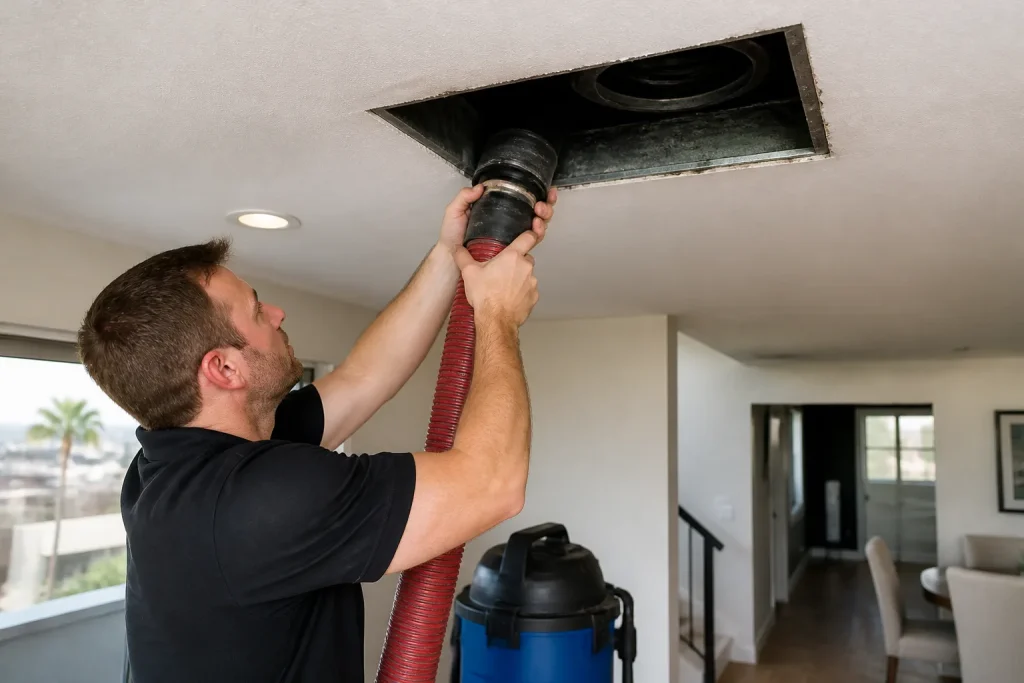
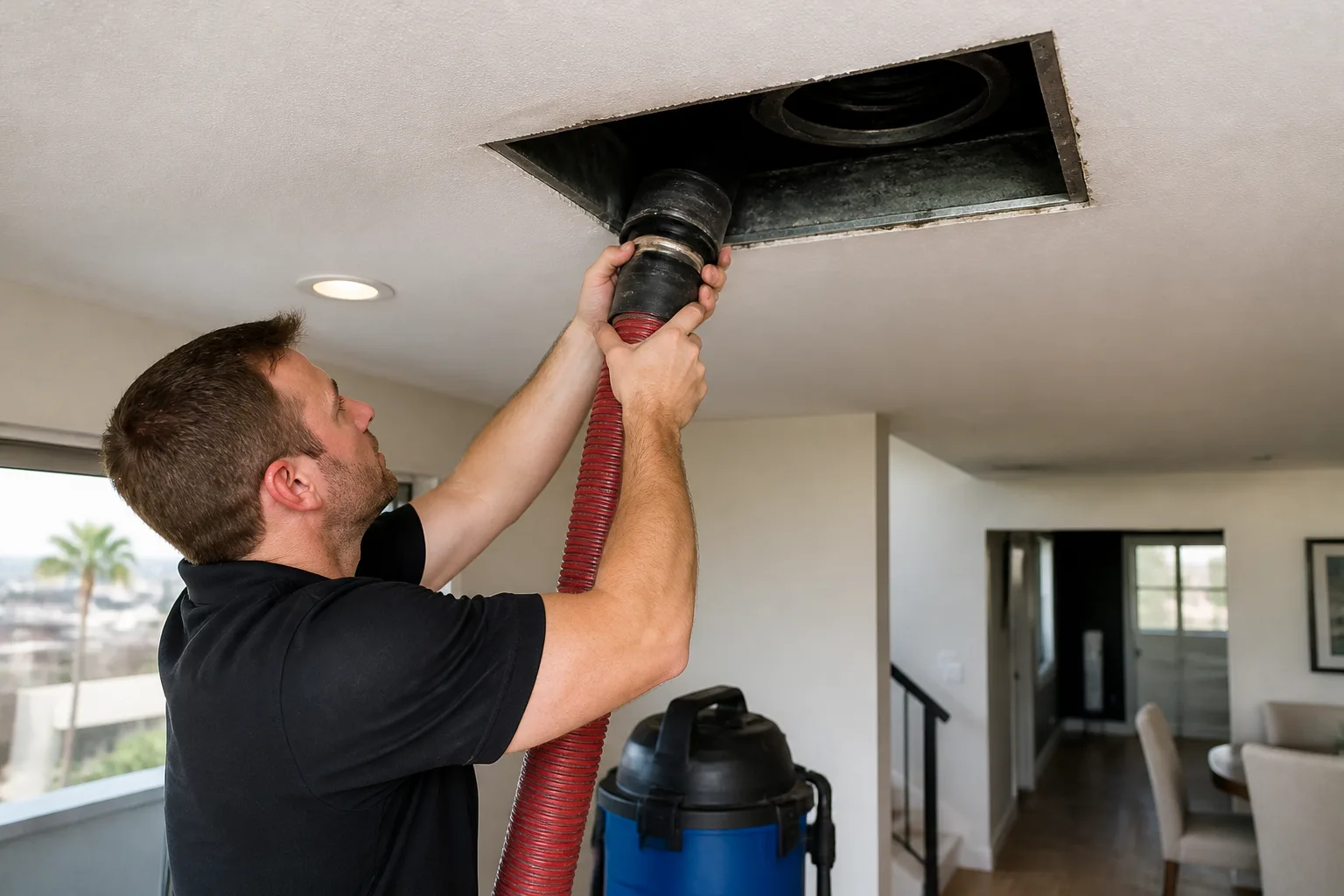
Air Duct Cleaning: Repair or Replace? How Los Angeles Homeowners Decide
Most Los Angeles homes don’t need their ducts replaced. They need a specific section repaired or resealed, then a proper cleaning. The honest answer usually comes down to material and condition, not age. In LA’s dry climate, sheet metal ducts can run 40 years with nothing but cleaning, while flex duct can collapse in ten. Before you pay for anything, you need to know which one you actually have.
If you’d rather not climb into the attic yourself, call (737) 727-2314 and we’ll tell you what you’re working with, free. But if you want to understand the decision before anyone shows up, here’s exactly how we break it down.
Know Your Duct Material Before You Decide Anything
Los Angeles housing spans nearly a century of building practices, and that matters more than how old your house is. The three duct types we see across the city fail in completely different ways. Your first job is figuring out which one is running through your walls and crawlspace.
Sheet metal ducts are rigid galvanized steel, common in LA homes built before 1970 and in many newer custom builds. They last decades, hold up to aggressive cleaning, and rarely need replacement unless rust, disconnected seams, or pest damage is present. If your system is sheet metal, cleaning is almost always the right call. The Rotobrush rotary brush systems we run handle these beautifully.
Flex duct is the silver corrugated tubing you see snaking through attics. Builders used it heavily in Los Angeles tract housing from the 1980s through the early 2000s because it was cheap and fast to install. The problem: it sags, tears at connection points, and collapses when the inner coil gives out. We regularly see flex duct in Encino and Sherman Oaks attics that’s flattened to half its original diameter. Cleaning a collapsed flex duct without repairing it first is wasted money. The air can’t move no matter how clean the surface is.
Ductboard is compressed fiberglass formed into rigid panels. You’ll find it in some 1970s and 1980s LA apartment buildings and older condo complexes. It’s the only duct type that can genuinely require full replacement in a single event, because fiberglass absorbs moisture. A roof leak, a humid coastal summer in Santa Monica, or an AC condensation overflow can saturate the material, and once it’s wet, it degrades fast and can hold mold. If you’ve got saturated ductboard, cleaning won’t fix it. It comes out.
How to Check Your System’s Integrity Before Booking a Cleaning
You don’t need special tools to spot the warning signs. We’ve walked thousands of Los Angeles homeowners through these three checks over the phone, and they catch the majority of repair-needs-in-disguise before anyone ever books a service.
Test the airflow at each vent. Hold a single sheet of tissue paper up to each register while the system runs. It should flutter actively, not droop or barely move. Walk the whole house and compare. If one room’s vents are weak while others are strong, you likely have a disconnected or collapsed section of duct on that branch line. Cleaning won’t solve it. A targeted repair will.
Check the temperature difference between rooms. On a hot day, run the AC and close your doors for an hour. Then walk through with a thermometer. If one bedroom runs five or six degrees warmer than the rest of the house despite a closed door and the system running, suspect restricted airflow on that run. In homes around the San Fernando Valley, we often find the culprit is a crushed flex duct where someone stored boxes on it in the attic.
Do a visual attic inspection. Bring a flashlight. Look for silver tubing that’s pinched, kinked, or hanging loose from its supports. Look for sections where the outer jacket is torn and the insulation is exposed. Look for disconnected joints where two sections have simply separated. If you see any of these, a standard cleaning is not your first step. Repair is.
What Each Path Actually Costs in Los Angeles
Here’s what we tell homeowners when they call asking for honest benchmarks. These are real LA market ranges based on what we quote and what we’ve seen from other reputable companies in the area. A standard whole-home air duct cleaning for a typical Los Angeles house runs $350 to $700. That’s a fair price for a system in good structural shape that just needs debris, dust, and allergen removal.
Repairing a collapsed or torn flex section runs $150 to $400 per section, depending on accessibility and how much of the run needs replacing. If your system has three bad sections, you’re looking at roughly $450 to $1,200 in repair work, still far less than replacement. For sheet metal systems, resealing a disconnected joint or patching a rusted section typically lands in the $200 to $500 range per repair.
Full duct replacement in Los Angeles runs $2,000 to $6,000 for a standard single-family home, with the spread driven by attic access, number of runs, and whether you’re replacing sheet metal with sheet metal or upgrading flex to a better grade. That’s a big number, and it’s why this decision matters. A lot of companies in this industry will quietly push you toward replacement because the invoice is larger. Our job is to tell you when you actually don’t need it.
How Los Angeles Specifically Triggers Replacement
The city has three failure patterns we see more than anywhere else, and they map directly to our climate and housing stock. If any of these sound like your situation, replacement gets more likely. None of them are your fault. They’re LA realities.
First: homes built between 1965 and 1995 often have original ductboard that’s simply reached the end of its service life. Four decades of dry heat cycling makes the fiberglass brittle. The adhesive at panel joints fails. Air leaks form everywhere. In neighborhoods like Westchester and Culver City, we see these systems losing 20 to 30 percent of conditioned air into attic spaces before it ever reaches a room. Cleaning can’t restore structural integrity.
Second: coastal properties. If you live within a few miles of the ocean in Venice, Playa del Rey, or Long Beach, your ducts are dealing with salt air and humidity that inland homes never see. Insulation wraps break down, condensation forms inside the duct runs, and flex duct outer jackets get brittle. We’ve pulled flex duct out of a garage in Mar Vista last week that crumbled in our hands like dry newspaper. That’s a replacement, not a cleaning.
Third: post-earthquake damage. Los Angeles homeowners who went through Northridge or any of the smaller quakes since often have duct connections that shifted slightly and never got checked. A one-inch separation at a boot connection leaks conditioned air into the attic for years. If you’ve been in your home through a quake and haven’t had the duct connections inspected, you might be paying to cool your attic. We see it constantly.
Why Documentation Matters at This Decision Point
This is where our approach to the cleaning-vs-repair question gets specific, because the worst position a homeowner can be in is paying for work they can’t verify on a system they can’t see. When we inspect a Los Angeles attic, we photograph what we find. Every torn section, every collapsed run, every gap at a connection gets documented before we quote anything.
Then you get a written price before any work begins. Not a verbal range, not a handshake number. A written quote that covers exactly the scope we identified. If the inspection reveals three torn flex sections and a healthy main trunk, your quote covers repairing those three sections and cleaning the rest. You’re not committed to a scope you haven’t seen justified. And when the work is done, you get before-and-after photos of your actual ducts, so you know what changed. That’s The Relay Standard, and it’s the only way we work. With Cardinal Air Duct Cleaning home services, you never pay for a repair someone tells you happened. You see it.
When to call a pro: if any of the three integrity checks above turned up weak airflow, temperature gaps, or visible damage, the inspection needs to happen before the cleaning. Booking a cleaning first is the mistake we hope you avoid. Cleaning a structurally compromised system is like detailing a car that won’t start. It looks better, sure, but it still doesn’t get you anywhere.
The Bottom Line
If your ducts are sheet metal in decent shape, clean them and keep them. If you’ve got flex duct with a few torn or collapsed sections, repair those sections and clean the rest. Replacement becomes the right answer when you’re looking at widespread failure: brittle ductboard that’s losing air everywhere, saturated insulation from moisture, or flex duct that’s collapsed across multiple runs. In Los Angeles, the most common mistake we see is homeowners paying for full replacement when two or three targeted repairs would have done the job at a quarter of the price. The reverse mistake, cleaning a system that needed replacement, costs less but buys nothing.
If you’re in Los Angeles and need an honest read on which path makes sense for your house, call Cardinal Air Duct Cleaning at (737) 727-2314 for a free estimate. We’ll inspect, photograph, and quote in writing. You decide from there. Related services: if your system is in good shape and you just need the cleaning done right, see our Air Duct Cleaning in Los Angeles page. If your dryer vent needs attention too, check out Dryer Vent Cleaning in Los Angeles.
Frequently Asked Questions
Check the material first, then the airflow. Sheet metal ducts almost always just need cleaning. Flex duct with visible sagging, tears, or collapsed sections needs targeted repair before cleaning. Ductboard that’s been exposed to moisture often needs full replacement. If rooms run different temperatures or vents have weak airflow, you likely have an integrity issue that cleaning alone won’t fix. Call (737) 727-2314 and we’ll help you figure out which situation you’re in.
Yes, if they’re sheet metal and structurally sound. Age alone is not a reason to replace. In Los Angeles we clean 40-year-old metal duct systems that are in better shape than 15-year-old flex systems. The deciding factor is material and condition, not years. A free visual inspection will tell you more than the age of your house ever will.
Repairing a collapsed or torn flex section typically runs $150 to $400 per section. Resealing a disconnected sheet metal joint runs $200 to $500 per repair. Full duct replacement for a standard LA single-family home runs $2,000 to $6,000. If your quotes are coming in near the replacement range, ask for the inspection evidence that justifies it. You should see photos of the damage, not just hear a number.
Because they’re not actually cleaning your ducts. The industry has a well-known bait-and-switch problem where a low price gets a technician into your driveway, and the invoice grows once the technician is inside. Ask any company you consider: what’s included in that price, who’s doing the work, and whether the price is written before anything starts. If they won’t put it in writing, that’s your answer. We hand every Los Angeles customer a written quote before a single duct is touched, and it doesn’t change at the door.
Written by the team at Cardinal Air Duct Cleaning.
Need Air Duct Cleaning Help?
Call Cardinal Air Duct Cleaning - licensed & insured, here with fast after-hours help in Los Angeles.
(737) 727-2314