
5 Mistakes to Avoid With HVAC Cleaning
If you’re about to schedule HVAC cleaning, the biggest mistakes aren’t about hiring someone unqualified – they’re about scope confusion. You say “clean my HVAC,” the technician hears “clean the ducts,” and you both find out at the invoice stage that the evaporator coil was never touched. Avoid these five mistakes and you’ll get what you actually paid for. If you’d rather skip the homework and just want a straight answer on pricing, call Cardinal Air Duct Cleaning at (737) 727-2314.
Key Takeaways
- “HVAC cleaning” and “air duct cleaning” are not synonyms – HVAC cleaning should include the coil, blower, and drain pan, while duct cleaning is just the pathways.
- The evaporator coil is the part that recontaminates clean ducts fastest when it’s skipped – and skipping it is the single most common corner cut in Los Angeles.
- During wildfire season, a technician who doesn’t seal registers before running negative-pressure equipment pulls outdoor particulate matter straight into the clean system.
- NADCA certification matters more than a business license because it requires documented equipment standards – ask to see it before booking.
- Pair HVAC cleaning with a media filter upgrade (we use Aprilaire) or you’ll be paying for the same job again inside two years.
Mistake 1: Assuming “HVAC Cleaning” Means the Same Thing as “Air Duct Cleaning”
Ask five HVAC cleaning companies in Los Angeles what “a full system cleaning” includes and you’ll get five different answers. Three of them won’t mention the evaporator coil – the part that degrades air quality fastest. Here’s the practical difference:
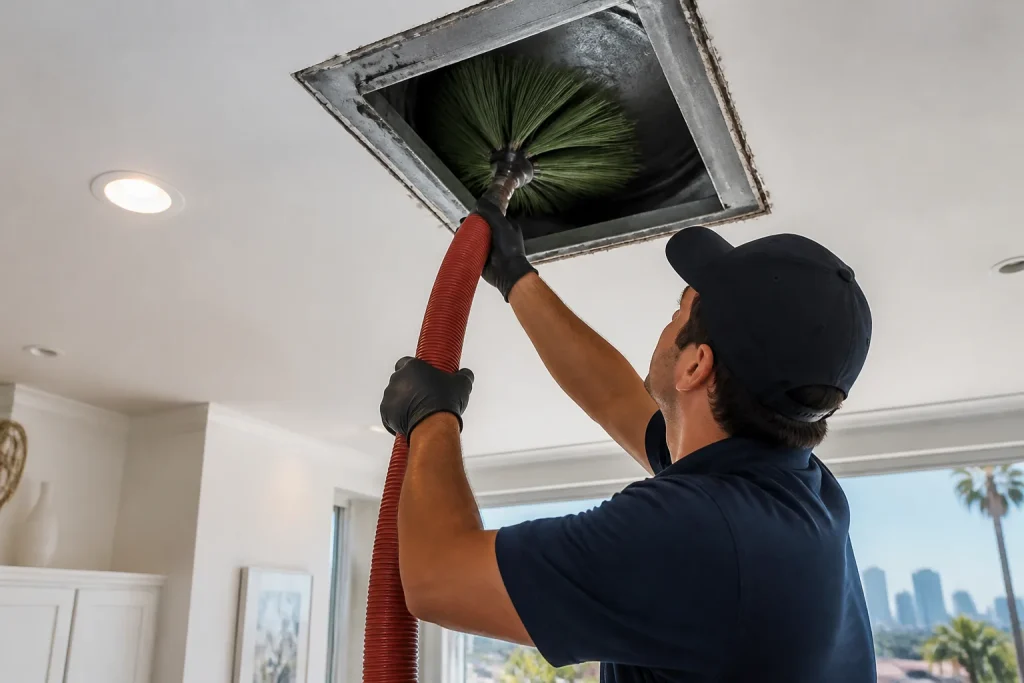
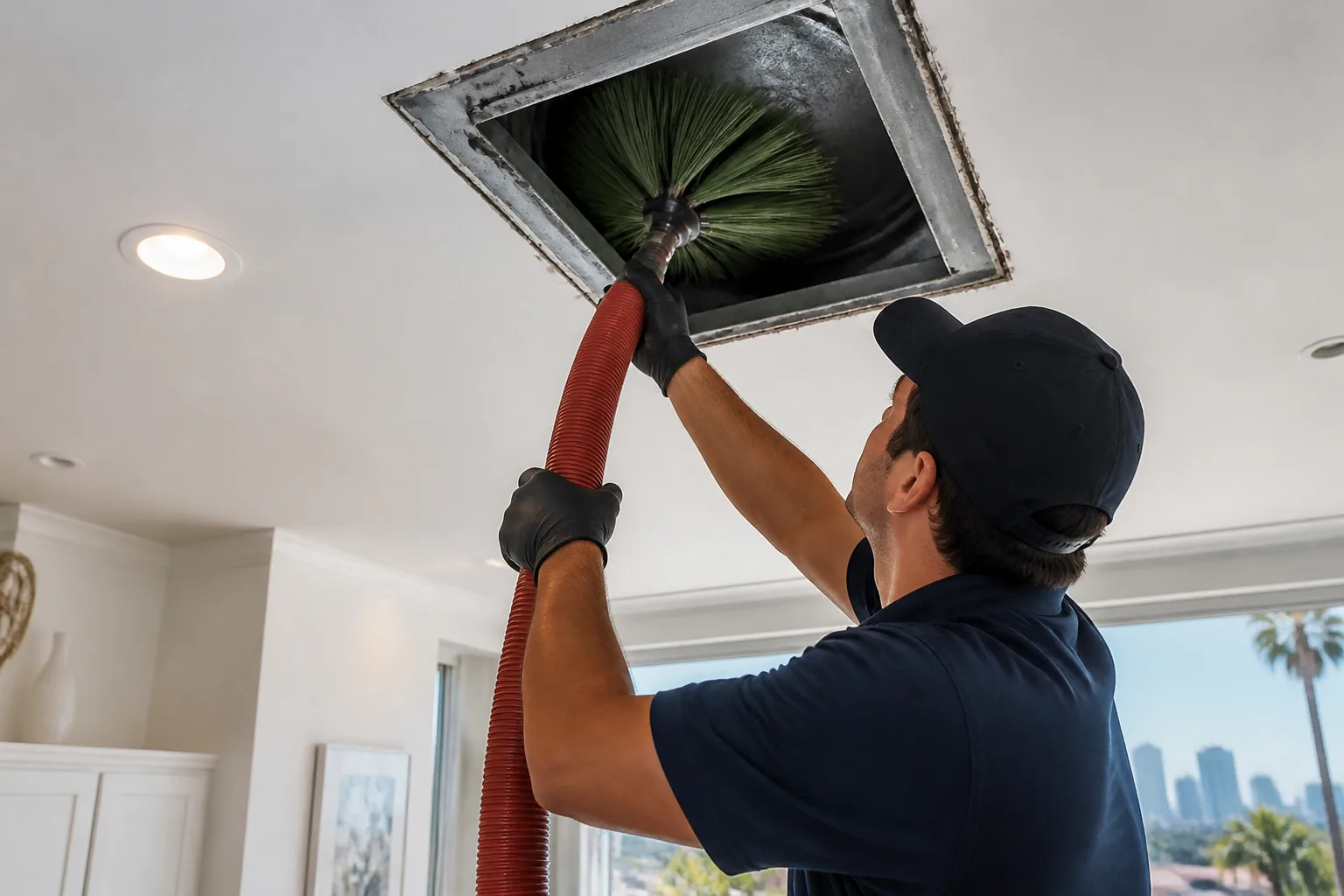
- Air duct cleaning covers the supply and return ductwork: the sheet metal or flex pathways that move conditioned air through the house. It involves rotary brushing and HEPA vacuum extraction, and most standard single-family homes in Los Angeles run $400 to $700 depending on system size and how many returns exist.
- HVAC cleaning should include the air handler, evaporator coil, blower wheel, blower motor housing, condensate drain pan, and the plenum boxes where the ducts connect. This is more labor and access work, often $300 to $500 on top of duct cleaning for a typical LA home.
- Equipment exterior cleaning means the condenser unit outside. It’s a separate job from the indoor system and usually runs $150 to $250 in the LA metro when done properly with coil-safe detergents and fin combing.
Why the confusion persists: half the industry built its business around duct cleaning alone, so that’s what they quote. We always list scope line-by-line on a written price before starting – you see exactly what’s covered before anyone touches a register. If your quote doesn’t break out the coil, ask why. The answer tells you a lot about what the job actually includes. For a complete breakdown of what a proper full-system job covers, see our HVAC Cleaning in Los Angeles service page.
Mistake 2: Cleaning the Ducts While Skipping the Evaporator Coil
This is the mistake we hear about most. A homeowner books duct cleaning, the technician does a decent job with the pathways, and the windows are left open to air out the house. Then six weeks later, dust is back on every surface, and the homeowner assumes the cleaning “didn’t work.” It worked. The coil didn’t. Here’s why:
The evaporator coil sits inside the air handler – it’s the part that gets cold while the AC runs. Air blows across it constantly. In a residential setting, that coil surface is almost always damp during cooling season. Damp plus dust equals a paste that bakes on. That baked-on layer keeps absorbing new dirt from the air stream and redistributing it through the ducts you just cleaned. It also insulates the coil, which reduces heat transfer. The compressor runs longer trying to satisfy the thermostat, which shortens equipment life and raises your summer DWP bill. We see this pattern across Los Angeles consistently, from Echo Park condos built in the 70s to newer track homes in Chatsworth – the coil condition determines how long clean ducts stay clean.
We clean coils with a dedicated coil-safe degreaser applied under controlled pressure, then rinse into the drain pan and clear the drain line so the water has somewhere to go. We use Rotobrush agitation on heavy buildup. A proper coil cleaning is not a spray-and-dash; on a badly fouled system it can take an hour alone. If a technician quotes you HVAC cleaning at a price that matches duct-only work, they’re skipping the coil or doing it with a visual wipe-down. Neither one fixes the problem.
Mistake 3: Scheduling During Fire Season Without Checking the Tech’s Containment Method
Los Angeles fire season isn’t an abstraction – it’s October through November, sometimes stretching into December, with AQI numbers that routinely cross 100 and spike past 200 during active burns. That matters for HVAC cleaning because of a technical detail most homeowners never hear about: negative-pressure extraction.
Negative-pressure extraction means the vacuum pulls air through the duct system while the brush agitates. Loose debris goes toward the vacuum intake rather than blowing out into the room. Good. Now the catch: when you run a powerful HEPA vacuum in negative pressure inside a house, air has to enter the system somewhere. If registers and grilles aren’t sealed, the system pulls air from outside through every unsealed gap – and that outside air is full of fine wildfire particulate, ash, and whatever else is riding the inversion layer. You end up with a freshly cleaned duct system and a house full of particulates the cleaning was supposed to remove.
The fix is basic but not universal: the technician seals all supply registers except the one being worked, manages pressure with a full-coverage containment setup, and switches from negative to positive pressure when appropriate so debris is pushed toward the vacuum, not pulled in from the roofline. We run Nikro HEPA vacuum units with Abatement Technologies containment gear specifically because it handles this job correctly. If the company you’re considering can’t explain their containment method in plain English, book a different week, not a different mood – or find someone who can. This applies especially to whole-home jobs in the Valley, where fire-season air is heaviest and homes typically run returns from outside air more often.
Mistake 4: Not Asking Whether the Technician Is NADCA-Certified
“Licensed and insured” is table stakes in Los Angeles – every legitimate HVAC contractor carries both. NADCA is a different bar. NADCA stands for National Air Duct Cleaners Association, and their certification process requires documented training in equipment standards, containment practices, and safety procedures. It’s a certification tied to the work itself: what vacuum equipment is acceptable, how to handle fiberglass-lined ductwork, how to protect the air stream during extraction. A business license never tests for any of that.
We carry NADCA certification because the written standard matters. It gives homeowners a benchmark that isn’t just our word. Ask any duct cleaner you’re considering whether their technicians are NADCA-certified, and if they hesitate or say “we clean to NADCA standards,” that’s not the same thing. The certification means someone verified the team, not that someone read a brochure. A real certification is documented and can be shown to you at the door – we show ours on request, just like the written price.
One more filter: ask what equipment brand they run. If the answer is “a truck-mounted vacuum,” ask whether it’s HEPA-rated or a gas-powered shop-vac on a trailer. We run Rotobrush brush systems for agitation, Nikro HEPA units for extraction, and Abatement Technologies containment so dust doesn’t migrate. You don’t need to know the names to spot a difference; just look for HEPA-rated extraction and containment equipment language in the estimate. That’s the small detail that weeds out most LA duct cleaners before you waste a booking slot.
Mistake 5: Treating HVAC Cleaning as a One-Time Event Without Upgrading Filtration
If you pay for cleaning and then replace the filter with the cheapest one at the hardware store, you’ve bought a temporary fix. The ASHRAE-consistent, real-world pattern in most LA homes is this: the existing filter is typically a 1-inch fiberglass panel rated MERV 4, which stops big debris and almost nothing else. The moment the system runs again, fine dust flows through the filter, into the coil, into the ducts. Inside a year the system looks like it was never cleaned.
The smart move is to pair HVAC cleaning with a media filter upgrade. We install Honeywell media cabinets and Aprilaire filtration – the whole-house kind that slots into the return plenum and holds a 4- or 5-inch MERV 11 or MERV 13 filter. That’s a meaningful difference. A MERV 11 catches mold spores and pet dander. A MERV 13 catches a significant percentage of the fine particulates that drive allergies and wildfire-smoke sensitivity. The tradeoff is slightly more static pressure, which is why you want a professional to check your blower can handle it before slapping in a high-MERV filter. We do that check as part of the quote – it’s not a caveat, it’s a calculation. In most homes built in Los Angeles since maybe 2010, standard ECM blowers handle MERV 13 fine. Older PSC blower motors need MERV 11 or a pressure check before going higher.
The practical benefit in real dollars: a media filter upgrade adds roughly $250 to $500 to the job depending on what you have now, but it extends the life of the cleaning from a year or two to three or more. You’re not paying a recurring subscription for clean air. You’re front-loading the solution. That’s the difference between treating HVAC symptoms and fixing the system that causes them.
When to Call a Pro
Let’s be straightforward about the DIY temptation. Changing a filter, wiping a return grille, and checking the drain pan overflow switch – those are homeowner tasks, fine to do yourself. But anything involving the evaporator coil, the blower wheel, or the interior of ductwork is not a weekend project. You’ll need professional-grade negative-pressure equipment, proper containment, and a plan for where the loosened debris actually goes. Skip that and you’ll blow years of accumulated dust into the house, which is worse than doing nothing. If you’re seeing dust return fast, uneven cooling between rooms, or a musty smell when the AC kicks on, that’s the point to call an HVAC cleaning specialist. In Los Angeles, the best way to know what you’re getting is to ask directly: “What does this price include, line by line?” and “Are your technicians NADCA-certified?” Any legitimate company answers both without hesitation.
Related services in Los Angeles: Air Duct Cleaning in Los Angeles covers the pathway cleaning described above. For the lint-filled, fire-risk side of the house, Dryer Vent Cleaning in Los Angeles is the page to read.
The Bottom Line
HVAC cleaning mistakes are almost always scope mistakes or savings mistakes disguised as poor workmanship. Get the scope written down: coil, blower, drain pan, ducts, plenums, and containment method. Confirm the person holding the brush is NADCA-certified, which covers the equipment and procedure standards your business license doesn’t. Don’t schedule during active fire season unless the technician can explain how they prevent outside contamination. And pair the cleaning with a media filter – that’s the move that actually keeps the air clean between visits. If you’re in Los Angeles and want a written quote that breaks all of this out line by line, call Cardinal Air Duct Cleaning at (737) 727-2314. We’re part of the Relay Home Co. family, which means every job includes a live trackable arrival window, before-and-after photos, and a digital invoice payable by link. We’ll show you the price before we touch a single register. That’s the whole point.
Frequently Asked Questions
For a typical single-family home in Los Angeles, full HVAC cleaning including ductwork, evaporator coil, blower wheel, and drain pan typically runs $700 to $1,200 total. Duct-only cleaning usually lands between $400 and $700. The coil and blower add $300 to $500. Every home is different – number of returns, system age, and coil condition move the number. We hand you a written price before work starts so there’s no door-knock surprise. Call (737) 727-2314 for a free estimate built from your actual system, not a national average.
Cheaper quotes in HVAC cleaning almost always mean less scope. The duct pathways get brushed and vacuumed, but the coil, blower, and drain pan are skipped – the parts that actually determine whether clean air stays clean. Some companies also run without NADCA certification, which lets them use cheaper equipment and less containment. You’ll see the price difference now and the dust difference in six weeks.
Ask for photo proof inside the coil housing, blower wheel, and a representative duct before and after. With The Relay Standard, every Cardinal job includes before-and-after photos you can view from your phone – no guessing what happened inside the air handler. If a company won’t show you the inside of the system after cleaning, that’s your answer.
In Los Angeles, every three to five years for a typical home, assuming you’re running at least a MERV 11 media filter and changing it regularly. Homes with pets, construction nearby, or wildfire smoke exposure every year will drift closer to three years. A clean evaporator coil and a good filter buy you the longer end of that window. But here’s the honest part: if you’re seeing visible dust emission, uneven cooling, or musty odors when the AC cycles on, the timing is less about calendar math and more about corrective maintenance. Call (737) 727-2314 and we’ll guide you to the right call for your home, even if that call is “you don’t need cleaning yet.”
Written by the team at Cardinal Air Duct Cleaning.
Need Air Duct Cleaning Help?
Call Cardinal Air Duct Cleaning - licensed & insured, here with fast after-hours help in Los Angeles.
(737) 727-2314