
Spring Air Duct Cleaning Checklist for Los Angeles Homes
Spring duct cleaning in Los Angeles is less about winter residue and more about getting ahead of what’s already circulating: juniper pollen, construction dust from infill development, and leftover ash from fall’s wildfire season. A duct system that’s been moving air through your home all winter has accumulated a layer of that debris on the blower, coil, and duct walls. When summer hits and your AC runs continuously, that same system moves it into every room. Here’s the checklist we give homeowners so they know what to verify before, during, and after a spring cleaning, plus the LA-specific triggers most checklists miss.
If you’d rather skip the prep work and have a pro handle it, call (737) 727-2314 for a free estimate. We’ll tell you exactly what needs doing and what it costs before anyone touches a vent.
1. Pre-Cleaning: What to Do Before the Technician Arrives
Most Los Angeles homeowners don’t think about their ductwork until the AC is already struggling. By then, they’re scheduling in the late-May rush, which means longer waits. The smarter play is March through April, when pollen is peaking but cooling demand hasn’t spiked yet. You can schedule at your convenience, and you’re resetting the system just before it starts working hard.
Before the technician shows up, run through this quick list:
- Map your vents and returns. Walk the house and count every supply register and return grille. Write down whether any are blocked by furniture, rugs, or boxes. A blocked return starves the system, and no amount of duct cleaning fixes a starved system.
- Do a tissue test at each register. Turn the fan on (no heat or cool, just “fan”). Hold a tissue near each supply vent. If one barely moves while others flutter, that room has an airflow restriction. Mention it to the tech before the job starts. This is the single most useful thing a homeowner can do pre-cleaning, because it tells us where the problem areas are.
- Change the filter before the cleaning, not after. A fresh filter means the system pulls in cleaner air during the work. After we’re done, your filter should stay clean longer because the ductwork isn’t reintroducing debris. Keep the old filter out so the tech can see what’s been coming through.
- Clear a path to the air handler and the return plenum. In LA, air handlers are usually in a closet, attic, or garage. If it’s a garage unit, move vehicles, bikes, and storage away. The tech needs roughly three feet of working clearance.
- Secure pets. Rotobrush equipment runs on a vacuum that’s loud enough to agitate a nervous dog. Put pets in a room that won’t be worked in.
These steps take 15 minutes and they give the technician a head start on diagnosing what’s actually going on, not just what’s visible through the vents.
2. The LA Spring Problem Most Checklists Miss
Spring in Los Angeles isn’t a season of thaw. It’s a season of pollen, dry wind, and the lingering aftermath of fall’s fires. Here’s what that means for your ducts:
- Pollen loading. Juniper and mulberry pollens peak in March and April across Los Angeles, regularly landing in the “very high” range on AQMD’s daily readings. Those particles are tiny enough to pass through a fiberglass filter and settle in the ductwork. Once they’re in there, every AC cycle redistributes them. One pollen-heavy spring can leave enough material in the duct walls to be a problem all summer.
- Santa Ana residue. Fall’s Santa Ana winds push fine dust and ash into every crack of a home. Much of it ends up pulled into the return air and deposited in the return plenum, the first chamber after the filter. By spring, that plenum can hold a surprising layer of sediment. If you had a smoky wildfire season anywhere near your neighborhood, that’s ash, and it’s sitting in your return.
- Construction dust. Los Angeles is one of the most construction-active metros in the country. If a house went up or a lot got graded within a block of you in the last year, the drywall dust and concrete fines from that site floated through the air and into your home. That dust is alkaline. It coats filters, packs into coil fins, and scores the inside of flex duct. Spring is the time to get it out, before the AC’s constant airflow grinds it in deeper.
- Moisture and mold. LA doesn’t get a wet winter every year, but when it does, humid air can ride through leaky duct runs and condense inside cool supply ducts. That’s the one scenario where you can get legitimate mold growth in ductwork. If you had any water intrusion, a leak, or a musty smell when the system first kicks on, spring cleaning should include an inspection of the supply runs for microbial growth. That’s not a standard air duct cleaning add-on; it’s a separate remediation process. Know the difference before you book.
Here’s the part most websites won’t tell you: if you had visible mold in the ductwork, cleaning alone doesn’t fix the source. You need the moisture cause addressed and the affected section either properly remediated or replaced. Ask any company you’re considering how they handle that. If they tell you cleaning handles mold, move on.
3. What the Spring Cleaning Should Actually Include
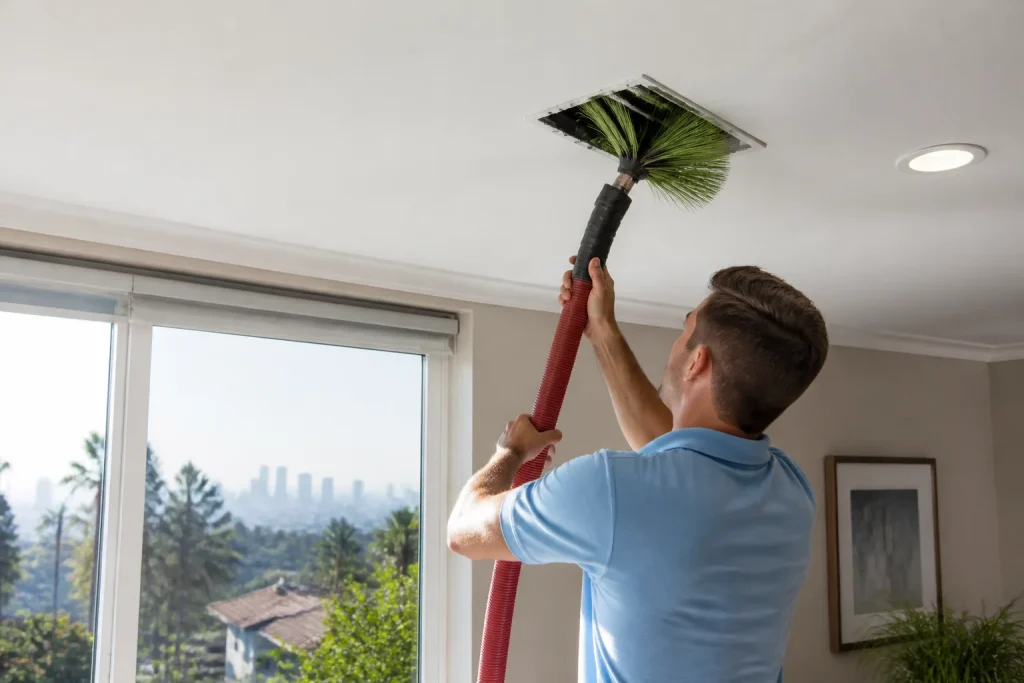
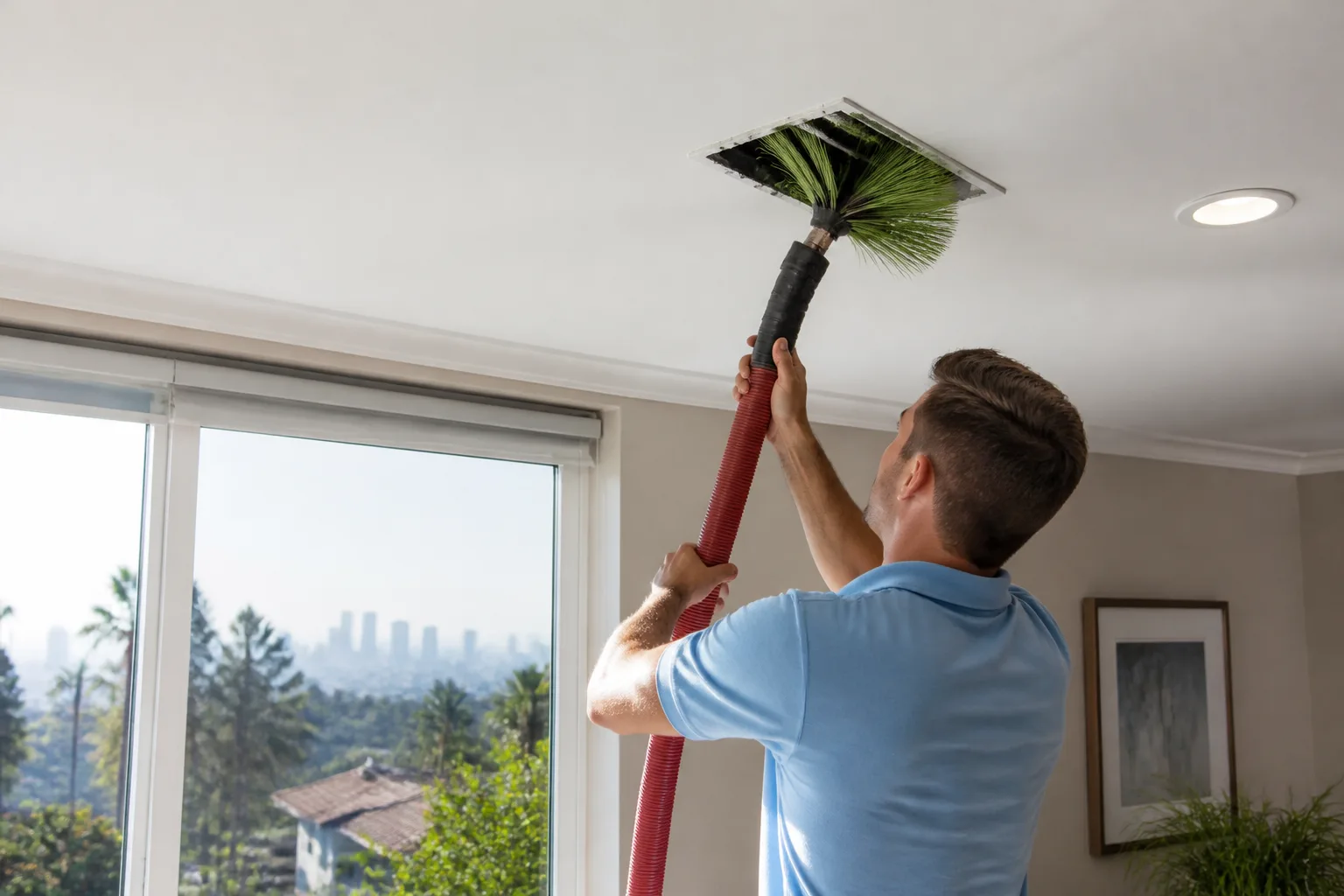
A proper air duct cleaning in Los Angeles is not a vacuum hose waved through a register. It’s a systematic process that covers the entire system, from return to supply. Here’s what we do, and what you should verify any company does before you hand over a credit card:
- Source removal, not just brushing. The industry standard is source removal: mechanically loosening debris and extracting it at the source, with the system under negative pressure. That means we attach a HEPA-rated vacuum (we run Nikro units) to the duct system, so the loosened debris is pulled into the vacuum, not pushed back into the rooms. If a company shows up with a truck-mounted shop vac and no negative-pressure setup, you’re not getting source removal. You’re getting a theater performance.
- Return and supply side, both cleaned. Both sides of the system need work. The return brings air in and is usually dirtier because the filter catches some of it. The supply side pushes air out and is where loosened debris from a poorly designed cleaning can end up. A proper job covers both, all the way to the register boots.
- The coil, not just the ducts. Spring is the best time to clean the evaporator coil. It’s the component that cools the air, and it sits directly in the airstream. After months of running, the coil collects a layer of crust: dust, pollen, and construction debris baked onto the fins by the heat. A dirty coil reduces heat transfer, which means the system runs longer to hit the same temperature. In Los Angeles summer electricity rates, a heavily fouled coil on a 2,000-square-foot home can add $40 to $70 a month to the bill, depending on usage. Cleaning the coil during the spring duct service costs a fraction of that.
- The blower assembly. The blower wheel is what pushes air through the house. A dirty blower wheel can throw the motor out of balance, causing premature bearing wear. While the system is open, the blower should be inspected and cleaned as part of the service. If a company only cleans the visible duct runs and never opens the air handler, they’re leaving the most important part of the system untouched.
- Register cleaning or at least inspection. The register itself, the metal or plastic grille at the end of each run, catches lint and pet hair. It should be removed, cleaned, and checked for airflow obstruction. Some companies skip this. Ask.
Professional-grade equipment matters here. We use Rotobrush for the mechanical brush work and Nikro HEPA vacuums for extraction. For larger jobs with significant debris, we also run Abatement Technologies containment units to prevent cross-contamination during the work. The equipment you see at the door tells you a lot about the result you’ll get. If the tech carries a single hose and not much else, adjust your expectations accordingly.
4. The Homeowner Checklist During and After the Job
Here’s what to verify while the work is happening, and what to ask for when it’s done:
During the job:
- Is the system under negative pressure? You should see a large vacuum hose attached to the system, either at the return plenum or at the air handler. That hose should be pulling air constantly during the work. If not, ask why.
- Is the tech opening the system? They should be cutting or accessing the plenum, not just working through register openings. A real cleaning accesses the trunk lines and branches. Through-the-register-only cleaning is incomplete.
- Is the tech covering the registers not in use? Professional crews seal off registers they’re not actively working on to maintain airflow control. If everyone is just going register to register with no containment, the negative pressure isn’t being managed properly.
After the job:
- Ask for before-and-after photos. Any company that stands behind its work should have photo documentation. If they won’t show you what the inside of the ducts looked like before and after, that’s a red flag. This is a hard requirement at Cardinal. We photograph every major section because you should see the work, not take it on faith.
- Request a written report of what was cleaned. This should list which sections were accessed, what was found, and what was done. No verbal-only summaries.
- Verify the airflow at each register. Run that tissue test again. Every register should show noticeably more airflow than before. If not, ask why.
- Check the coil if it was part of the service. The tech should show you the coil before and after. A cleaned coil looks bright metal, not a gray-brown mat.
- Confirm the guarantee in writing. Ours is the 365-Day Done Right Promise: if the work isn’t right within a year, we come back and correct it at no charge. If your company won’t put a guarantee in writing, that’s your answer.
Here’s a real example from a job we did in the Valley last spring: a homeowner on a hillside street in Sherman Oaks called because one bedroom never cooled properly. The tissue test showed almost no airflow. We found the flex duct feeding that room had been crushed during a roof repair the prior summer. Cleaning alone wouldn’t have fixed it. Because we documented the airflow before and after, the repair was scoped correctly and the room finally held temperature. If she’d just called a company that vacuums registers and leaves, she’d still be running a portable AC today.
5. What to Expect in Time and Disruption
For a 1,500-square-foot Los Angeles home with a single air handler, a complete duct cleaning with coil service runs 2 to 4 hours. For a 2,500-square-foot home or a system with an attic air handler, expect 4 to 6 hours. Add time if the system has multiple zones or if there’s significant debris from construction or wildfire season.
During that window, the HVAC system will be off. The house won’t be heating or cooling. In April, that’s usually fine in LA. In late May or June, when temperatures start hitting 85-plus, a full-day system shutdown is uncomfortable. That’s another reason to book March through April, before the first real heat wave.
In terms of disruption, the techs will need access to the air handler and all registers. They’ll move room to room with equipment. You can stay home, work from home, or leave. One thing worth noting: the system is under negative pressure the whole time, which actually keeps dust from spreading through the house. You shouldn’t have a dusty mess afterward. If you do, that’s a sign the containment wasn’t set up right.
When to Call a Pro
If any of these apply, skip the DIY route and get a professional assessment:
- You see visible debris blowing from supply registers when the system starts.
- The registers show a gray or black film around the edges, which is fine dust that’s been circulating for months.
- One or more rooms won’t hold temperature no matter how you adjust the dampers.
- Your energy bill jumped from one year to the next with no change in usage or rates.
- You had a leak, roof damage, or any water intrusion near the air handler in the last year.
- You smell a musty or stale odor when the fan runs, especially after the system has been off.
If you’re in Los Angeles and you’d rather have someone else handle the checklist, our team does this every day. For related services, we also offer dryer vent cleaning in Los Angeles and full HVAC cleaning in Los Angeles. You can see the full scope of what we do on our Cardinal Air Duct Cleaning home page.
The Bottom Line
Spring duct cleaning in Los Angeles is best viewed as AC readiness, not a chore to put off until the heat forces your hand. Get the pollen, construction dust, and any wildfire residual out of the system before summer demand turns your blower into a distributor. Run the tissue test, change the filter, and have the coil cleaned while the system is open. Verify the company uses source removal with negative pressure, documents the work with photos, and puts a guarantee in writing.
If you’re in Los Angeles and need help, Cardinal Air Duct Cleaning offers free estimates with a written price before any work starts. Call (737) 727-2314 and we’ll walk you through the scope for your home, whether it’s a Silver Lake bungalow or a five-bedroom in Calabasas.
Frequently Asked Questions
Every 3 to 5 years for most homes, but in Los Angeles that window tightens to every 2 to 3 years if you live near active construction, had wildfire smoke reach your neighborhood, have pets that shed heavily, or have someone in the home with allergies or asthma. The key variable is what’s in the air around you, and LA air carries more particulate than most coastal cities. Call (737) 727-2314 and tell us your situation; we’ll give you an honest recommendation, not a sales pitch.
Most standard air duct cleanings in Los Angeles run $400 to $900 for a typical single-family home, depending on system size, number of returns, and whether the coil and blower are included. Homes with multiple zones or significant construction debris may run higher. Be wary of the $99 specials; those are almost always a foot-in-the-door price that climbs once the tech is inside. Ask for a written price before any work starts. Call (737) 727-2314 for an exact quote; estimates are free.
It helps when the ducts are actually dirty and contributing to the particulate load in your home. If your filter is changed regularly and the system is sealed properly, the ductwork collects less. But in LA, where pollens and construction dust are constant, a dirty system can absolutely recirculate allergens. Cleaning removes that reservoir. It’s not a cure for outdoor allergies, but it removes a source of re-exposure inside the house. Call (737) 727-2314 and we can assess whether your system is a real contributor or not.
You can change filters, vacuum accessible registers, and keep vents clear. You can’t effectively clean the interior of the ductwork without professional negative-pressure equipment, access to the air handler, and the right tools. We use Rotobrush brush systems and Nikro HEPA vacuums because they’re built for this exact job. Home vacuum attachments won’t reach the debris sitting in the trunk lines. If you’re going to pay for a cleaning, make sure it’s done right. Call (737) 727-2314 for an assessment or a quote.
Written by Omar Haddad, Owner at Cardinal Air Duct Cleaning, serving Los Angeles since 2005.
Need Air Duct Cleaning Help?
Call Cardinal Air Duct Cleaning - licensed & insured, here with fast after-hours help in Los Angeles.
(737) 727-2314