
How Los Angeles Weather Affects Your Air Duct Cleaning
Los Angeles weather shapes what ends up inside your ductwork more than almost any other factor. The city’s five distinct microclimates, Santa Ana winds, drought cycles, and marine layer each deposit different types of debris into your system, which means the cleaning method that works for a Venice bungalow is often wrong for a Woodland Hills tract home. A duct cleaning in Los Angeles isn’t a one-size-fits-all job, and understanding what your specific neighborhood’s weather puts into your ducts will tell you how often you actually need service and which approach will actually work.
Key Takeaways:
- LA’s microclimates mean different neighborhoods accumulate completely different duct debris.
- Santa Ana winds force fine particulate into return ducts through building envelope gaps.
- Drought years make LA ducts accumulate debris faster than the national 3 – 5 year recommendation.
- Coastal humidity can create mold conditions inside fiberglass-lined flex duct that vacuum-only cleaning won’t fix.
- The best month to clean your ducts in Los Angeles depends on where in the city you live.
LA Has No Single Climate, So Your Ducts Don’t Have a Single Problem
Most national duct cleaning advice assumes every home faces the same conditions. That assumption falls apart fast in Los Angeles. Within 30 miles, you’ve got inland valleys hitting 100°F in September while coastal neighborhoods sit in 65°F fog. A home in Van Nuys deals with dry heat and wildfire ash, while a condo in Santa Monica fights marine layer humidity year-round. These aren’t minor differences. They change what’s inside your ducts, how fast it builds up, and what it takes to remove it.
In the San Fernando Valley, including Woodland Hills and Van Nuys, we typically find fine dust, ash, and brittle particulate. The air is dry, and when wildfires burn in the nearby hills, that ash gets pulled into HVAC returns and settles into duct lining. It’s abrasive and light, meaning it recirculates easily every time the system kicks on.
Coastal homes in Santa Monica, Venice, and Marina del Rey show a different profile. Marine layer moisture keeps duct interiors damp, especially in older homes with fiberglass-lined flex duct. That moisture binds with dust to form a film, and in enough time, that film becomes a substrate for mold. We’ve opened ducts in Venice where the liner looked like it had been painted gray. That’s not paint.
Hillside neighborhoods like Mount Washington or the canyons above Malibu add another variable: rodents. Vegetation proximity means more entry points for pests, and duct runs in crawl spaces become nesting spots. What looks like a simple cleaning job sometimes turns into a removal and sanitation situation.
Santa Ana Winds: The Dust Loader Nobody Talks About
When Santa Ana winds hit 60 mph, they don’t just knock over trash cans. They pressurize your home. That’s not a metaphor. Offshore winds push against exterior walls, and the pressure differential between outside and inside forces air through every gap in the building envelope: window seals, door frames, can lights, attic hatches, and especially return ducts that run through unconditioned spaces.
That air carries fine particulate from the desert and, in fire season, smoke and ash. The return side of your HVAC system operates under negative pressure. When the house is pressurized by outside wind, that negative pressure pulls contaminated air directly into the return ducts. The result is a layer of ultra-fine dust coating the inside of your return runs within a single day of strong Santa Anas.
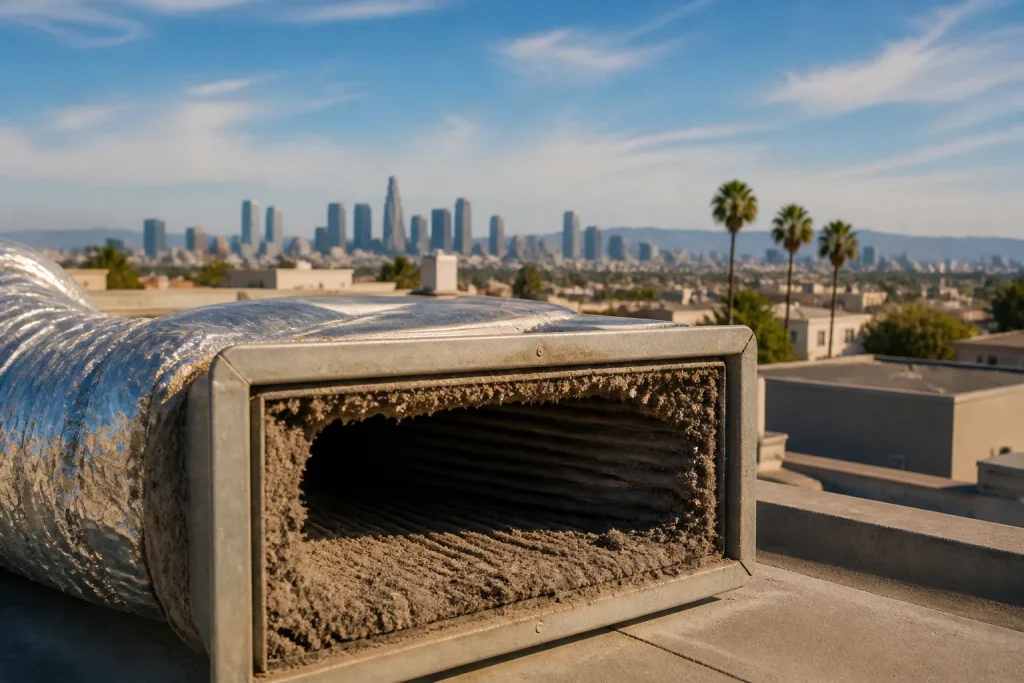
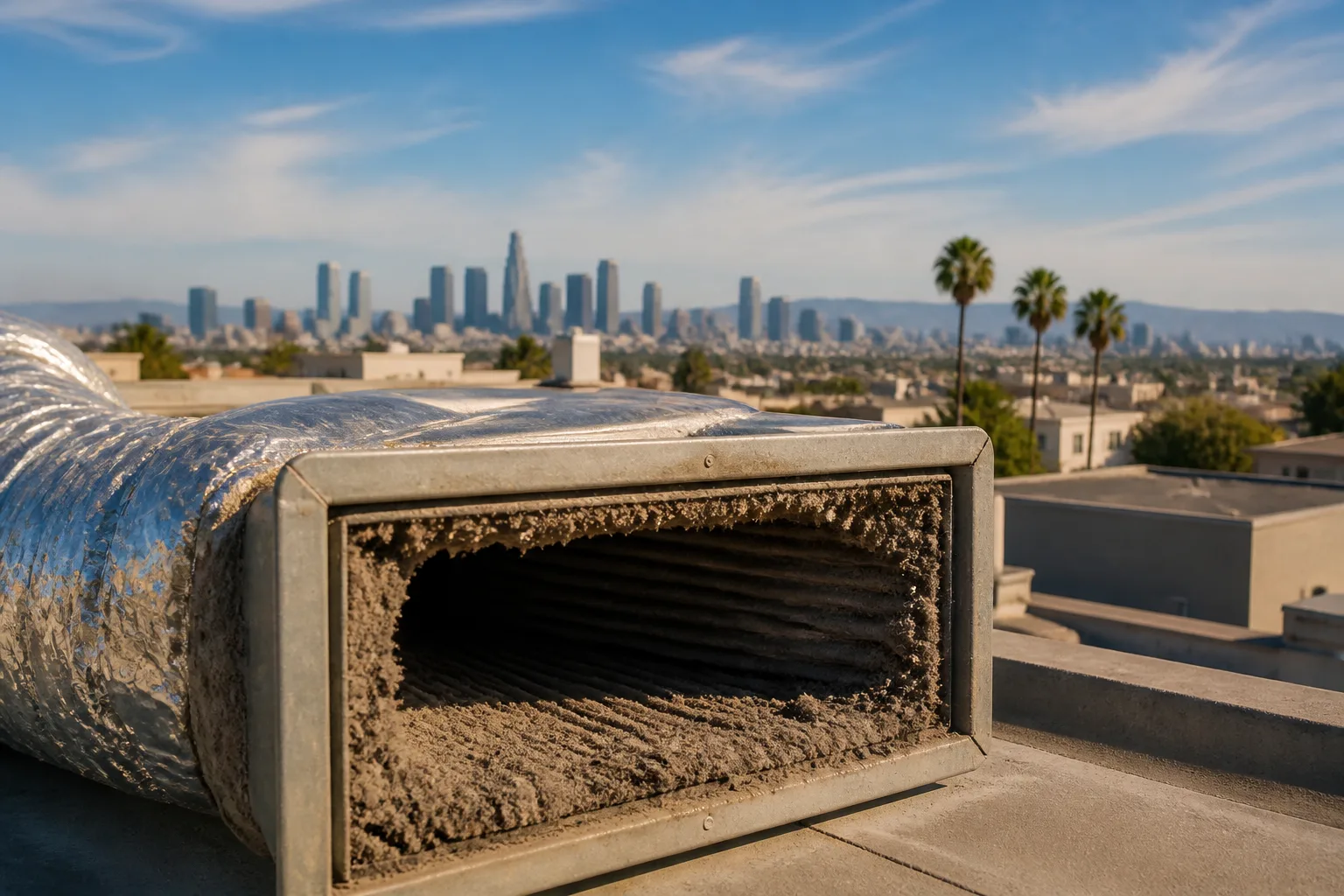
Here’s what that looks like when we put a camera through a system after a wind event: the supply side may still look relatively clean, but the return side looks like it’s been dusted with flour. Fine particulate is the hardest material to remove with a basic vacuum system. It requires high-efficiency agitation plus HEPA-rated negative-pressure extraction, meaning the loosened debris goes straight into the vacuum, not back into your living room. That’s why we run Rotobrush systems paired with Nikro HEPA vacuums on these jobs. A truck-mounted shop vac won’t touch that fine material. It just redistributes it.
Drought Years Fill LA Ducts Faster Than the National Average
The standard advice you’ll hear is to clean your air ducts every three to five years. That recommendation comes from national averages that don’t account for Los Angeles’s drought cycles. In normal humidity, dust and particulate settle out of the air relatively quickly. In Southern California’s dry years, humidity drops low enough that fine particulate stays airborne far longer before settling, which means more of it gets pulled into your HVAC system.
We’ve cleaned systems in Los Angeles homes after two dry years that looked like they hadn’t been touched in a decade. One job over in Northridge last summer, the homeowner had a cleaning done three years prior, and the return plenum already had a solid quarter-inch of packed dust. That’s not unusual in a drought year. The air is just dirtier, longer.
Here’s the practical takeaway: if Los Angeles has had two consecutive below-average rainfall years, you can reasonably cut the national cleaning interval in half. That means cleaning every two to three years instead of every three to five. It’s not a sales pitch. It’s just what dry air does to duct accumulation rates.
The type of dust also matters. Dry-year dust is finer and less sticky than humid-climate dust. It moves easily through the system and coats every surface evenly. Humid-climate dust clumps and gathers at joints and corners. Different debris profiles require different cleaning approaches, which is another reason the same cookie-cutter method fails across a city as varied as Los Angeles.
Marine Layer Humidity and the Mold Problem in Flex Duct
Coastal Los Angeles homes face a specific problem that inland homes rarely see: mold growth inside fiberglass-lined flex duct. Here’s the mechanism. Marine layer humidity keeps outdoor relative humidity above 70% for many hours per day during late spring and early summer. Your HVAC system pulls that humid air into the return ducts. Fiberglass duct liner is porous. It absorbs moisture. When dust and organic matter settle onto that damp liner, you’ve created a food source and a water source in the same place. Add darkness, and mold has everything it needs.
Once mold establishes itself in flex duct liner, a standard vacuum cleaning won’t solve the problem. The mold is inside the material, not on its surface. Vacuuming removes the surface layer but leaves the roots intact, and the problem returns within months. For fiberglass-lined flex duct with confirmed mold growth, the correct approach is either Abatement Technologies encapsulation, which seals the liner, or full duct replacement. Anything less is a temporary hedge.
This is where equipment choice matters. Abatement Technologies containment units create a sealed negative-pressure environment during the cleaning or encapsulation process, so mold spores don’t spread into the living space while the work is happening. We use that same equipment on any Los Angeles coastal job where we find visible liner growth. Not every home needs it. But when it’s needed, skipping it is the difference between fixing the problem and just rearranging it.
If you’re in Santa Monica, Venice, Playa del Rey, or any neighborhood within a few miles of the coast, and your home has flex duct that’s more than ten years old, it’s worth having the liner inspected during your next cleaning. The inspection costs nothing extra in a standard cleaning, and finding moisture issues early keeps a maintenance job from becoming a replacement job.
When to Schedule Your Duct Cleaning in Los Angeles: A Month-by-Month Logic
The generic “clean in spring and fall” advice fails in Los Angeles because our seasons don’t match the national pattern. Here’s the scheduling logic that actually applies to LA’s weather calendar:
- September through November: Best window for inland Valley homes (Woodland Hills, Van Nuys, Sherman Oaks, Northridge). This follows the worst of the summer heat and typically precedes the strongest Santa Ana months. Cleaning before peak wind season means you start with clean ducts when the particulate load hits.
- December through February: Worst window for coastal homes. Marine layer is thickest, humidity is highest, and cleaning a system in peak damp conditions often leads to re-accumulation within weeks. Wait until the marine layer starts breaking up.
- March through May: Best window for coastal homes (Santa Monica, Venice, Marina del Rey). The marine layer begins thinning, and you’re cleaning before the summer tourist season’s ambient particulate increases.
- June through August: Solid window for most of Los Angeles. Dry air means quick drying after any interior duct work, but wildfire smoke can undo a cleaning within days. If there’s an active fire within 20 miles, postpone.
- Immediately after a significant Santa Ana wind event: If you live in an older home with known envelope gaps, a post-wind cleaning can capture the particulate that just got forced into your returns. This is especially relevant for homes near the 405 corridor and foothill communities.
The point isn’t to schedule on a national cadence. It’s to match your cleaning to what your Los Angeles neighborhood’s weather actually did.
Related Services in Los Angeles
The same weather factors that affect your air ducts also affect your dryer vent and HVAC system. Here’s how we handle each in Los Angeles:
- Dryer Vent Cleaning in Los Angeles removes the lint accumulation that Santa Ana particulate combines with to create blockages. Dry vent lines in Valley homes with long horizontal runs are especially prone to compaction during dry, dusty seasons.
- Air Duct Cleaning in Los Angeles covers the full return and supply system, including the microclimate-specific debris profiles described above. Every job includes a written price before work begins and before-and-after photo documentation.
- HVAC Cleaning in Los Angeles goes deeper than the ducts themselves, addressing the blower motor, evaporator coil, and plenum where fine particulate and coastal moisture accumulate most aggressively.
What happens when you call
- 1
A real person answersNo phone trees - you reach a local pro.
- 2
You get an upfront price rangeHonest numbers before anyone is dispatched.
- 3
A background-checked tech heads outLicensed & insured, dispatched right away.
- 4
You approve before work beginsNothing starts until you say go.
The Bottom Line
Los Angeles weather doesn’t just affect how often you need duct cleaning. It determines what’s inside your ducts, which cleaning method will actually work, and when in the calendar year the job will hold up best. Inland Valley homes deal with heat and ash. Coastal homes fight marine layer moisture and mold potential. Every home in the city faces the Santa Ana wind effect at least a few times a year. The answer to “how often should I clean my ducts?” is completely different for a condo in Santa Monica than it is for a house in Van Nuys.
If you’re in Los Angeles and want to know what’s actually inside your ducts, Cardinal Air Duct Cleaning home offers free estimates and camera inspections. Every job includes a written price before any work starts, a live arrival window you can track, and before-and-after photos so you know exactly what you paid for. Our 365-Day Done Right Promise means if the work isn’t right within a full year, we come back and make it right at no charge.
When to call a pro: if your home has gone more than three years without a duct cleaning, if you live in a wildfire-adjacent neighborhood, if your coastal home has flex duct older than a decade, or if you’ve noticed musty smells when the system runs, it’s time. Call (737) 727-2314 for a free estimate and we’ll send a background-checked, uniformed technician who runs Rotobrush and Nikro equipment, not a shop vac bolted to a van.
Frequently Asked Questions
Weather determines both what enters your ducts and how fast it accumulates. Dry inland air keeps fine dust and wildfire ash airborne longer, pulling more into your returns. Coastal humidity creates damp conditions inside fiberglass-lined flex duct, which can support mold growth. Santa Ana winds pressurize your home and force outdoor particulate through envelope gaps into the return side of your HVAC system. Each weather condition produces a different type of contamination, and different contamination requires different cleaning approaches. Call (737) 727-2314 for an exact quote and a camera inspection of what’s actually in your system.
In most Los Angeles neighborhoods, yes, especially during drought years. The national 3 – 5 year recommendation assumes average humidity and relatively clean outdoor air. Los Angeles’s dry cycles, wildfire smoke, Santa Ana particulate, and coastal moisture all accelerate accumulation speeds. In dry years, we’ve seen systems look like they haven’t been cleaned in a decade after only two or three years. If you’ve had two consecutive below-average rainfall years, cleaning every two to three years is the more honest interval for most LA homes. Call (737) 727-2314 to get a free estimate based on your neighborhood and system condition.
It can, and it does more often than most homeowners realize. Marine layer humidity keeps moisture in the air for hours at a time, and fiberglass-lined flex duct absorbs that moisture. When dust and organic matter settle onto damp liner, mold has the conditions it needs to grow. Once mold is inside the liner material, vacuum cleaning alone won’t remove it. The liner needs encapsulation with containment equipment like Abatement Technologies units, or the duct needs replacement. If you live within a few miles of the coast and your flex duct is over ten years old, it’s worth an inspection. Call (737) 727-2314 and we’ll schedule a camera inspection with a free estimate.
Yes, and it depends on where you live. Inland Valley homes are best cleaned between September and November, before the strongest Santa Ana winds arrive. Coastal homes should wait until March through May, when the marine layer begins to thin and humidity drops. The summer months work well for most of Los Angeles, except when wildfire smoke is active within 20 miles. Avoid cleaning coastal systems in December through February, when peak dampness causes rapid re-accumulation. If you want a recommendation specific to your neighborhood, call (737) 727-2314 and we’ll talk through what your local weather has been doing.
Written by Omar Haddad, Owner at Cardinal Air Duct Cleaning, serving Los Angeles since 2005.
Need Air Duct Cleaning Help?
Call Cardinal Air Duct Cleaning - licensed & insured, here with fast after-hours help in Los Angeles.
(737) 727-2314