
Honeywell Dryer Vent Cleaning in Los Angeles: A Homeowner’s Guide
If your Honeywell smart home system just pushed a dryer vent alert to your phone, you’re likely staring at one of two realities: a $40 DIY maintenance task, or a fire hazard that’s been building for years behind your walls. In Los Angeles, the answer usually comes down to one number: the length of your vent run. Under 25 feet with no sharp bends, you can often clear it yourself. Over 25 feet, or any run with more than one elbow, and you’re in pro territory. If you’d rather not crawl behind your dryer to find out, call (737) 727-2314 and we’ll take a look for free.
Here’s the thing most guides won’t tell you: Honeywell doesn’t make dryer vent cleaning equipment. They make sensors, smart thermostats, and home monitoring systems that flag problems. The search “Honeywell dryer vent cleaning” is usually a homeowner who just got an alert and is trying to figure out what it means. This guide meets you at that exact moment.
What Your Honeywell Sensor Is Actually Telling You
Honeywell’s lint alert systems, like the ones integrated into their smart home hubs or standalone dryer vent alarms, measure one of three things depending on the model: airflow restriction, temperature rise at the dryer exhaust, or back pressure inside the vent pipe. When the sensor trips, it’s not telling you there’s a fire. It’s telling you the airflow has dropped below a safe threshold. In most LA homes, that threshold is crossed when lint builds up enough to block 30 to 40 percent of the vent’s interior diameter.
Here’s what that actually means in practice. A dryer needs to push roughly 100 to 150 cubic feet per minute of hot, moist air out of your house. When the vent narrows, the dryer’s internal temperature climbs. The thermal fuse inside your dryer is designed to blow at around 196°F to 220°F. Lint itself ignites at approximately 400°F. Your sensor trips long before either of those numbers, which is good. It’s an early warning, not a fire alarm. But the gap between “sensor alerted” and “dangerous” closes faster in Los Angeles than it does in, say, Seattle, because our dry air makes lint more brittle and more likely to break loose and lodge deeper in the run.
One more thing worth knowing: false positives happen. A sensor can trip because the vent termination cap outside is blocked by a bird’s nest, a dryer sheet that got sucked into the line, or simply because the sensor’s battery is low. Before you book anything or start unscrewing panels, check the basics at the wall first.
Why Los Angeles Homes Have Unique Vent Routing Problems
LA’s housing stock creates vent challenges you won’t find in a lot of other cities. We’ve cleaned vents in West Adams bungalows, Silver Lake hillside homes, and Koreatown condos, and each layout has its own particular headache. The common thread across all of them is this: stucco.
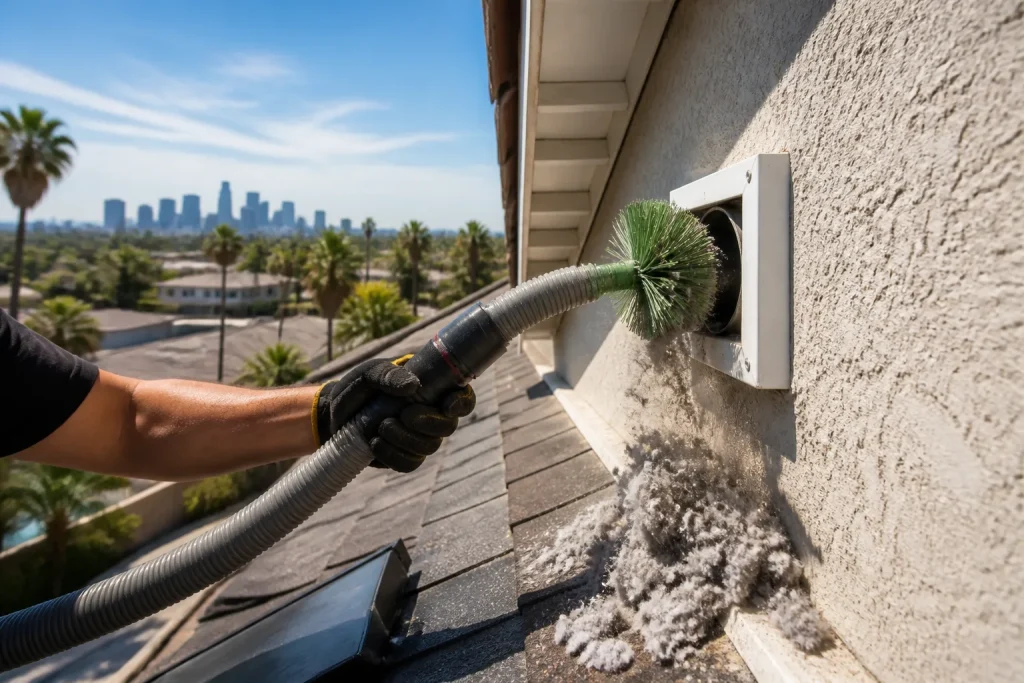
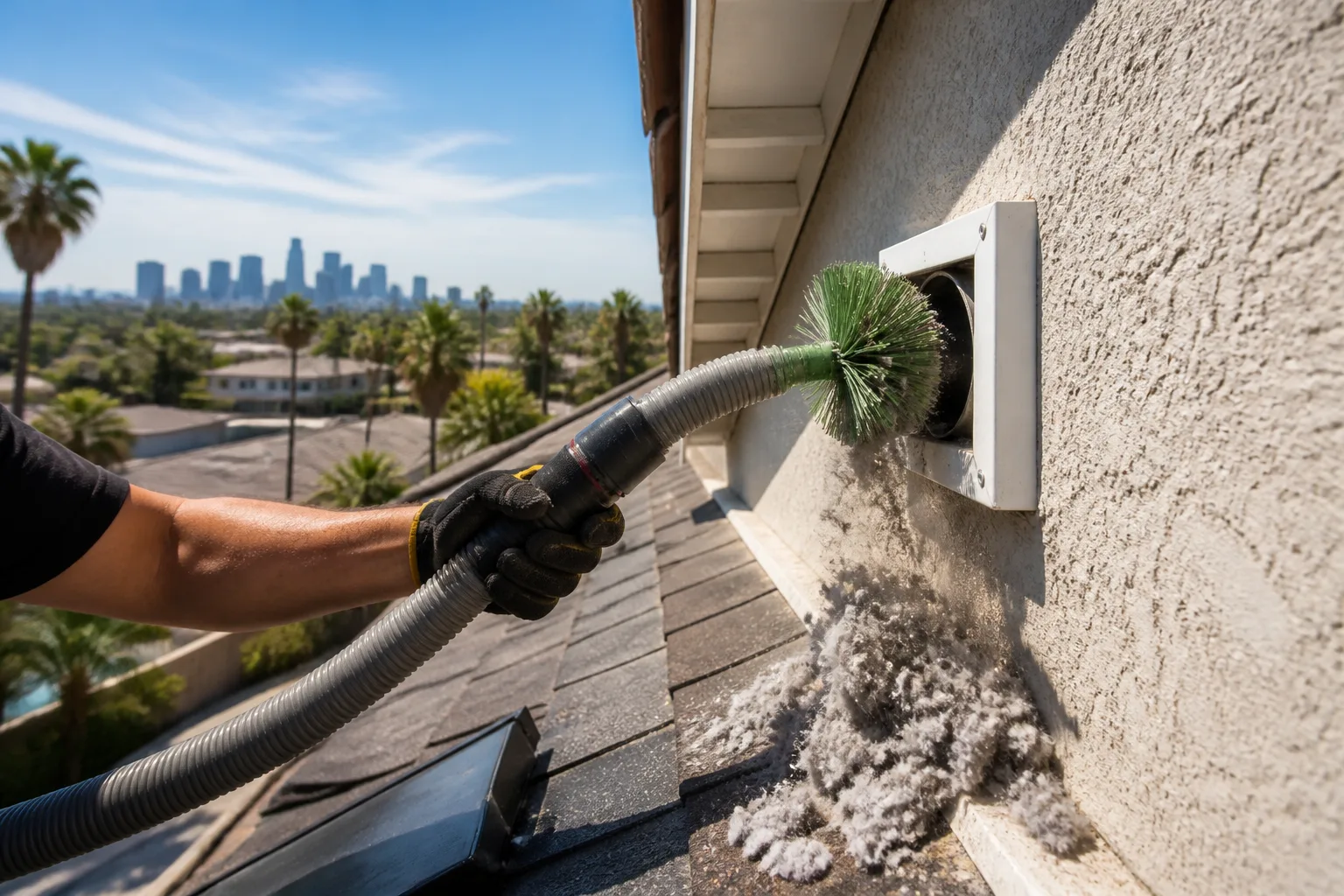
Most Los Angeles homes built after 1950 are stucco exterior. The vent termination cap – that little flapper or louvered grille on the outside wall – is often sealed into the stucco with a bead of caulk or stucco patch material that’s been painted over multiple times. Removing it for inspection without cracking the surrounding stucco takes patience and the right tool. We’ve seen homeowners chip out a 6-inch crater around the cap trying to pry it loose with a flathead screwdriver. That’s not a DIY fail; it’s a stucco reality.
Multi-unit buildings add another layer. Condos and apartment conversions in neighborhoods like Mid-Wilshire or Palms frequently have shared vertical vent stacks. Your dryer on the fourth floor is pushing air into a common riser that serves every unit below you. If any of those units has a clog, the whole stack backs up. Your Honeywell sensor trips, and the actual blockage might be two floors down behind someone else’s wall. In those buildings, the HOA or building management is legally responsible for the common stack, but enforcement is spotty. If you’re in a condo and your sensor keeps tripping even after cleaning your own portion of the run, the stack itself is the prime suspect.
Ranch and bungalow styles, common in the Valley and the Eastside, usually have shorter, straighter runs. That’s the good news. The bad news is that those shorter runs often terminate through the roof instead of a side wall. Roof terminations clog more slowly but are harder to clean from the ground, especially after Santa Ana winds deposit a season’s worth of dust and palm debris onto your roof.
The Vent Run Length Rule: DIY vs. Pro
The dryer manufacturer’s spec sheet almost always states a maximum equivalent vent run length, usually 25 to 35 feet. “Equivalent” matters because every elbow counts against you: a 90-degree elbow adds 5 feet of resistance, and a 45-degree elbow adds 2.5 feet. A 10-foot straight run with three 90-degree turns is, to your dryer, a 25-foot run.
Here’s the practical rule we use in the field:
- Under 25 feet, no more than one elbow: This is a candidate for DIY cleaning. You can buy a basic vent brush kit at any hardware store for about $25 to $35, run it through the pipe from the dryer side, and vacuum out what falls loose. Time cost: 45 minutes if you’re handy.
- 25 to 35 feet, or two elbows: Technically within dryer spec, but sitting right at the edge. If your Honeywell sensor is tripping regularly, the buildup is winning. A pro with a rotary brush system – we run Rotobrush units – will clear it more thoroughly in less time than you’ll spend fighting it yourself.
- Over 35 feet, or any run with three or more elbows: This is pro territory, full stop. Long Los Angeles runs need powered agitation (rotary brushes that spin inside the pipe) plus negative-pressure extraction – that means the loosened debris goes straight into the vacuum, not back into your laundry room.
We pulled a clog out of a garage-side vent in Los Angeles’s Westchester neighborhood last month where the run measured 42 feet with four elbows. The homeowner had been cleaning the first 4 feet with a brush and assumed the rest was fine. His Honeywell sensor kept tripping because the remaining 38 feet had been collecting lint for what looked like two years. The restriction was so severe the dryer was taking three cycles to dry a single load of towels.
How to Locate and Inspect Your Vent Termination Cap in LA
Before you call anyone – including us – take five minutes to find your vent’s exit point. On a typical Los Angeles single-family home, the cap is on an exterior wall, usually within 10 feet of the dryer’s location, either straight through the wall behind the dryer or on the wall adjacent to it. On ranch homes in the San Fernando Valley, check the wall in the garage if the dryer backs up to it. On hillside homes in Echo Park or Mount Washington, the vent often exits through the foundation in the crawlspace, which is a whole different access problem.
Once you find the cap, look for:
- Flapper movement: The little door should swing open freely when the dryer is running. If it’s frozen shut, that’s restriction.
- Visible lint accumulation: Any fuzz around the cap edges means buildup inside is likely worse.
- Caulk and stucco condition: A cracked seal lets moisture into the wall cavity, which can rot framing over time.
- Pest debris: Birds, rodents, and wasps love dryer vents. If you see nesting material, the vent needs a full clear-out and possibly a pest-proof cap replacement.
For condos and apartments, this is where it gets tricky. In many LA multi-unit buildings, the termination cap for your vent is on a shared shaft wall or rooftop you can’t access without building management’s help. If that’s your situation, document the sensor alerts on your phone, request access from your HOA in writing, and if they drag their feet, call a licensed vent cleaning company – California requires dryer vent cleaning to be performed by a company with the proper contracting credentials, and we’re happy to walk you through that conversation.
What a Professional Dryer Vent Cleaning Actually Includes
This is the part where the industry’s reputation gets shaky, and we’ve been honest about it since day one. Some companies quote a low base number like $60 over the phone, then add fees once the technician confirms the run is “longer than expected” or “needs special equipment.” By the time the van door closes, you’re at $250 for a job the neighbor paid $90 for.
We don’t work that way. Our price is written before a single duct is touched, and it covers the complete job: rotary brush agitation with professional Rotobrush equipment, full negative-pressure HEPA extraction using Nikro vacuum systems, and verification that airflow at the termination cap matches manufacturer spec. If the run needs extra work – say, a corroded pipe section or a broken termination cap on stucco – that’s a separate line item with its own price, agreed before we start that portion. No surprises at the door.
For most single-family homes in Los Angeles, a standard dryer vent cleaning runs $149 to $249 depending on run length and access difficulty. Condo and multi-story building cleanings where roof access or lift equipment is required are priced on a case-by-case basis. You’ll know the number before we unload anything from the truck.
Related services in Los Angeles: If your dryer vent is clogged, your home’s Air Duct Cleaning in Los Angeles system likely hasn’t been done either, and a full HVAC Cleaning in Los Angeles is worth considering in the same visit.
What happens when you call
- 1
A real person answersNo phone trees - you reach a local pro.
- 2
You get an upfront price rangeHonest numbers before anyone is dispatched.
- 3
A background-checked tech heads outLicensed & insured, dispatched right away.
- 4
You approve before work beginsNothing starts until you say go.
The Bottom Line
When your Honeywell sensor trips, treat it as a real signal, not noise. The faster you address reduced airflow, the smaller the problem stays. A lint clog in a 20-foot run is a $40 Saturday fix. The same clog in a 45-foot run behind stucco is a pro job with specialty equipment. If you’re in Los Angeles and want the answer for your specific home, we’ll come out, measure the run, and give you a written price before any work starts. That goes for every job, from a standalone Dryer Vent Cleaning in Los Angeles to a full Cardinal Air Duct Cleaning home system service.
Call (737) 727-2314 and a live person answers. No call tree, no voicemail, no callback tomorrow. We’ll get you on the schedule and give you a trackable arrival window so you know exactly when we’ll be there.
Frequently Asked Questions
No. Honeywell makes sensors, thermostats, and smart home monitoring systems that detect airflow problems and temperature changes in your dryer exhaust. The cleaning itself is done with rotary brush and HEPA vacuum equipment from companies like Rotobrush, Nikro, and Abatement Technologies – the equipment we use on every Los Angeles dryer vent job.
Most single-family home dryer vent cleanings in Los Angeles run $149 to $249, depending on the length of your vent run and how accessible the termination cap is. Condo and multi-unit cleanings may cost more if roof access or lift equipment is involved. Cardinal Air Duct Cleaning gives you a written price before any work starts, so you know the number before we begin. Call (737) 727-2314 for a free estimate.
Run your dryer on high heat for 15 minutes, then go outside and check the termination cap. If the flapper is barely moving or not moving at all, airflow is restricted and the sensor is probably right. If the cap moves freely but the sensor still trips, check the sensor’s battery and position first. If both check out, call a pro to do an airflow measurement – we do that as part of every service call in Los Angeles.
If your vent run is under 25 feet with no more than one elbow, yes, DIY cleaning with a brush kit is reasonable. If your run is over 25 feet, has multiple elbows, or terminates through a roof or shared condo stack, call a professional. Los Angeles stucco exteriors make termination cap access riskier than it looks, and rotator brush equipment reaches buildup a hand brush physically can’t.
Written by Omar Haddad, Owner at Cardinal Air Duct Cleaning, serving Los Angeles since 2005.
Need Air Duct Cleaning Help?
Call Cardinal Air Duct Cleaning - licensed & insured, here with fast after-hours help in Los Angeles.
(737) 727-2314