
HVAC Cleaning: Repair or Replace? How Los Angeles Homeowners Decide
Here’s the short answer: repair when the equipment itself is sound but the system is struggling, replace when the unit has a terminal failure like a cracked heat exchanger or a dead R-22 compressor. But in Los Angeles, the decision almost never hinges on the unit’s age alone. It hinges on whether the ducts delivering that air are worth investing in, and most contractors never bring that up. If you’d rather not sort this out on your own, call (737) 727-2314 and we’ll walk you through it.
Here’s the number that gets missed in nearly every contractor’s kitchen-table pitch: a brand-new $8,000 Carrier or Lennox system loses up to 30% of its efficiency pushing conditioned air through a leaking, debris-laden duct network. That’s not a worst-case scenario. We measure it regularly in Encino ranch houses and Silver Lake bungalows. You’re not buying a new HVAC system. You’re buying a new HVAC system plus whatever the ducts let through. Those are two different purchases, and the second one doesn’t show up on most replacement quotes.
Key Takeaways
- A duct assessment should happen before any repair-or-replace decision in Los Angeles, because leaking or clogged ducts can mimic equipment failure.
- The “5,000 BTU rule” contractors use for sizing doesn’t hold up across LA’s climate zones, from coastal Long Beach to inland Encino.
- Clogged evaporator coils caused by dirty ducts are often misdiagnosed as compressor failure, leading to thousands in unnecessary replacement costs.
- California’s Title 24 energy code sets SEER2 minimums for new equipment, but old duct systems can prevent those rated efficiencies from ever being reached.
- Some problems, like R-22 refrigerant phaseouts and cracked heat exchangers, mean replacement is the honest call even after cleaning.
The Repair-or-Replace Question Most LA Contractors Skip
When a homeowner in Los Angeles calls us about a struggling HVAC system, the conversation usually starts with the unit. How old is it? What’s the compressor doing? Is the blower motor whining? Those are fair questions. But here’s the thing: a significant portion of the “dead” systems we’re asked to evaluate in neighborhoods from West Adams to North Hollywood aren’t dead at all. They’re starving. The blower is pushing air, but the evaporator coil is caked with the kind of fine dust that settles in ducts after years of dry, dusty Santa Ana seasons. The compressor keeps tripping its thermal overload because it’s working against a restriction nobody looked for.
In our experience at HVAC Cleaning in Los Angeles, the repair-or-replace conversation should always start with airflow. What’s the static pressure across the coil? What does the return-side duct look like? Is the filter slot actually holding a filter, or is air bypassing it entirely? These are $150 diagnostic questions that can save a homeowner from a $14,000 replacement they didn’t need. A dirty duct system doesn’t just reduce comfort. It creates conditions that make a healthy unit act like a failing one, and that’s when the high-pressure sales pitch arrives.
One tool we use on every evaluation is a simple before-and-after static pressure reading. When the numbers normalize after a proper cleaning with negative-pressure extraction, that means the air is moving again, and the unit often settles right back into normal operation. No replacement required. That’s the kind of visibility every Los Angeles homeowner deserves before signing a financing agreement.
Why the 5,000 BTU Rule Breaks Down Across Los Angeles
Every HVAC contractor learns a rule of thumb: roughly 5,000 BTUs per 400 to 600 square feet of living space, depending on ceiling height, insulation, and window count. It’s a starting point. But Los Angeles is not one climate. A 1,800-square-foot home in Encino, where August afternoons hit 104 degrees and the air is bone dry, has a completely different cooling load than the same home in Long Beach, where the marine layer keeps afternoons in the low 80s and humidity sits above 60 percent for much of the summer. A unit sized for Encino will short-cycle in Long Beach, which means it never runs long enough to dehumidify, and the homeowners end up cold and clammy instead of comfortable.
Short-cycling is also a duct problem, not just a sizing problem. When a system’s ducts are restricted by years of accumulated dust and pet hair, the coil gets colder than designed, and the system shuts off early to protect itself. The house never reaches setpoint. The homeowner assumes the unit is too small or too old, and a contractor quotes a bigger replacement. Meanwhile, the actual fix is cleaning the ducts and restoring designed airflow. We’ve documented this exact pattern in Lake Balboa and Mid-City homes where the original equipment was perfectly adequate for the space.
That’s why we say the BTU math only works when the duct system is functioning at spec. If you’re in Los Angeles and your system has never kept up, or it runs constantly without satisfying the thermostat, get the ducts evaluated before you accept a replacement quote. The Air Duct Cleaning in Los Angeles process we run includes airflow measurement, so you’ll know with numbers whether your ductwork is part of the problem.
How Dirty Ducts Cause “Failure” That Isn’t Failure
Here’s a scenario we see repeatedly: a homeowner in the San Fernando Valley calls because their AC stopped cooling. The technician arrives, hooks up gauges, and announces the compressor is “going bad” and the unit “probably has a year left.” The quote comes in at $12,000 for a new system. But nobody pulled the blower door. Nobody looked at the evaporator coil. Nobody checked whether the return duct was pulling 400 CFM or 200 CFM.
Here’s what’s actually happening in a lot of those cases. The evaporator coil, which sits directly in the airflow path, is accumulating a layer of dust and debris that acts like insulation. The refrigerant inside the coil can’t absorb heat from the air efficiently, so it runs back to the compressor as a liquid instead of a gas. That liquid refrigerant is the enemy of a scroll compressor. It slugs, overheats, and trips. The unit “fails.” But the root cause isn’t the compressor. It’s the coil. And the coil got dirty because the ducts were dirty and the filter wasn’t doing its job.
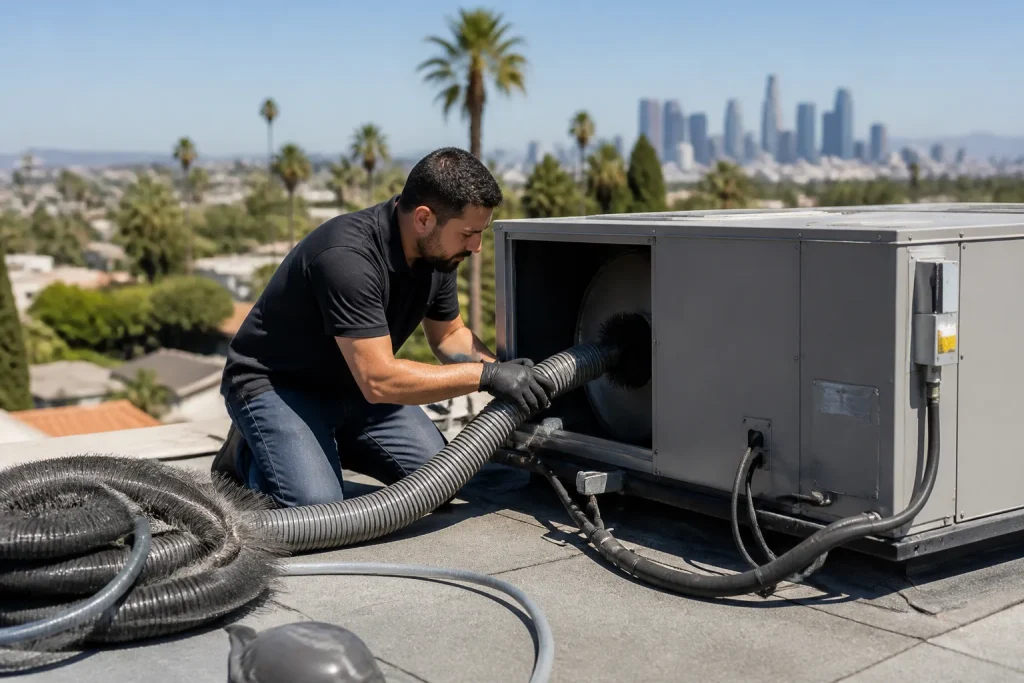
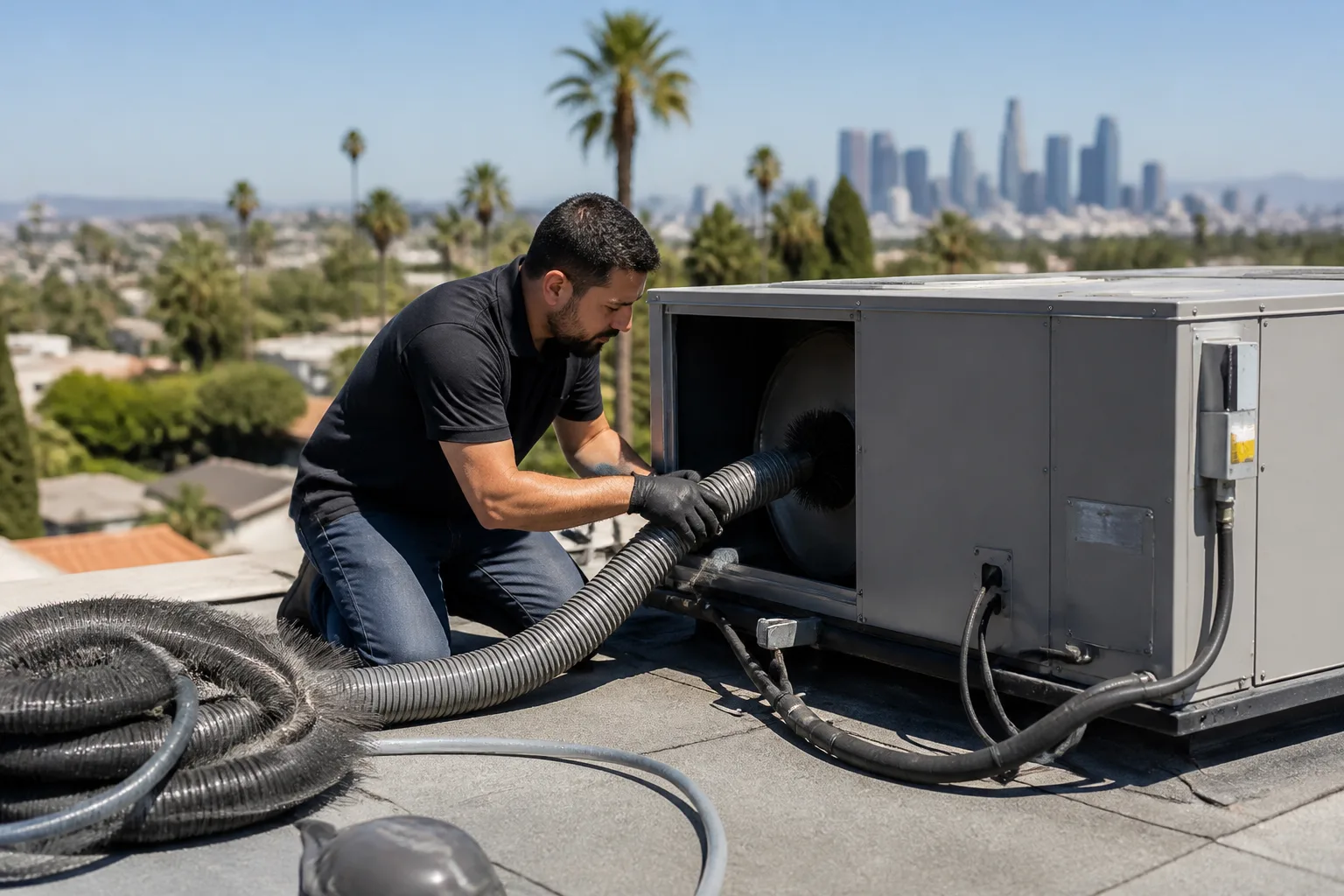
A proper HVAC cleaning that includes evaporator coil access and treatment costs a fraction of what a replacement costs. In Los Angeles, a thorough duct cleaning plus coil cleaning typically runs $450 to $950 for a standard single-system home, depending on the number of supply and return drops and the level of contamination. A replacement system runs $7,500 to $16,000 before any duct modifications. That’s a meaningful spread. And when cleaning restores the system to full function, the replacement question disappears. For details on what a full HVAC cleaning includes, see our Cardinal Air Duct Cleaning home service overview.
The Real ROI Math: Cleaning vs. Replacement in Los Angeles
Let’s put real numbers on this. Los Angeles contractor pricing for HVAC work has risen steadily over the last five years, driven by refrigerant phaseouts, SEER2 efficiency standards, and labor costs. Here’s what homeowners in the LA area can expect to pay for common scenarios:
- Duct cleaning plus coil treatment: $450 to $950 for a typical single-system home. Add $150 to $300 if the blower wheel needs pulling and cleaning.
- Duct sealing, if needed: $600 to $1,800 depending on the number of leaks and accessibility. Aeroseal-style injectable sealants run higher.
- Full system replacement (furnace + AC + coil): $7,500 to $16,000 before any duct work, permits, or Title 24 testing.
- Duct replacement: $4,000 to $9,000 for a typical LA single-story home, more if the ducts run through slab or need asbestos abatement.
The math gets interesting quickly. If a $700 cleaning restores a 9-year-old system to full efficiency and reliable operation, that’s about 5 to 10 percent of the cost of replacement. And it buys you years of additional service life, during which you can plan for replacement on your own schedule instead of reacting to a failure in the middle of a July heat wave.
There’s a second layer to the ROI equation. A system paired with clean, properly sealed ducts uses less electricity to move the same amount of air. We recommend Aprilaire media filters and Honeywell controls on systems where filtration has been neglected, because a clogged filter destroys efficiency faster than almost anything else. But the foundation is always the ductwork. Clean ducts plus a clean coil equals a system that runs less and cools more.
What California Title 24 Means for Your Replacement Decision
California’s Title 24 Building Energy Efficiency Standards set minimum efficiency ratings for new HVAC equipment installed in the state. Current requirements call for minimum SEER2 ratings in the 14.3 to 15.2 range depending on the system type and capacity, with higher minimums for certain climate zones in inland Los Angeles County. If your existing equipment is older than about 2015, it’s almost certainly below current standards, and a replacement unit will be more efficient on paper.
But here’s the catch that rarely gets discussed during a sales call: a high-efficiency replacement unit only reaches its rated efficiency if the duct system is in good condition. Leaking return ducts pull hot attic air into the system, which forces the unit to work harder and erases efficiency gains. Undersized or badly kinked supply ducts increase static pressure, which reduces airflow and makes the coil work inefficiently. Title 24 sets the standard for the equipment, but no code on earth can make a 15 SEER2 unit perform at 15 SEER2 when it’s breathing through a dirty, leaky duct system.
So the sequence matters. If you’re replacing because of a genuine equipment failure, plan for duct assessment and possible sealing or replacement as part of the same project. Abatement Technologies containment units are critical on older Los Angeles homes where duct removal can disturb decades of dust, and a professional crew will set up containment before cutting into any trunk line. If you’re replacing primarily because the system isn’t performing, get the ducts cleaned and tested first. You might find the replacement is unnecessary. That’s the honest conversation we have with homeowners in Los Angeles every week.
Red Flags That Mean Replacement Is the Right Call
We don’t hesitate to tell a homeowner when replacement is the correct decision. Cleaning is not a miracle cure, and there are specific conditions where continuing to repair an old system is throwing good money after bad. Here are the red flags we look for that indicate replacement is the smart move, even after a thorough cleaning:
- R-22 refrigerant systems: R-22 was phased out of new production in 2020. If your system leaks and it uses R-22, the refrigerant alone can cost $150 to $300 per pound on the remaining inventory, and a full recharge can run $1,000 or more. That’s money with no long-term future, because the system will leak again and the supply will only get scarcer.
- Cracked heat exchangers: In gas furnaces, a cracked heat exchanger is a carbon monoxide risk and a mandatory replacement item. No cleaning addresses this. If a technician finds a crack, replace the furnace or the entire system.
- Asbestos-wrapped duct trunk lines: Homes built before 1980 in Los Angeles often have duct insulation containing asbestos. If the ducts are degrading and the wrap is friable, cleaning can disturb hazardous material. Professional abatement and full duct replacement are the only responsible path.
- Compressor burnout with acid contamination: When a compressor burns out, the refrigerant oil becomes acidic, and that acid travels through the entire system. A proper repair requires replacing the compressor, flushing the lines, replacing the filter drier, and cleaning the coil. On a system over 12 years old, that repair often totals 40 to 60 percent of replacement cost, and the remaining components are still old.
When we find any of these conditions in a Los Angeles home, we say so plainly. Our job is to give you the information to make the right call, not to sell you a service you don’t need. That’s the Done Right Promise in action: if the work isn’t right within 365 days, we return and correct it at no charge. That promise applies to every booking, no exceptions.
When to Call a Pro
If you’re reading this and thinking, “I don’t know whether my ducts are dirty, my coil is clogged, or my compressor is failing,” that’s exactly the moment to bring in someone who can measure it. A professional evaluation that includes static pressure readings, coil inspection, duct inspection, and a look at the filter setup will tell you more in 45 minutes than three replacement quotes will tell you in a week. We run those evaluations across Los Angeles every day, and we hand you a written price before any work starts, so you know exactly what you’re approving.
For homeowners dealing with related issues, we also handle Dryer Vent Cleaning in Los Angeles, which addresses a different set of airflow and safety concerns in the laundry room. A clogged dryer vent is a fire hazard that follows the same logic: restricted airflow makes the system work harder and fail sooner.
The Bottom Line
Start with the ducts. In Los Angeles, the repair-or-replace decision for HVAC equipment can’t be made honestly without knowing whether the duct system is delivering the air the equipment produces. Dirty or leaking ducts can mimic equipment failure, and cleaning plus coil treatment costs a small fraction of replacement. If cleaning reveals a terminal problem like a cracked heat exchanger, an R-22 system with a leak, or asbestos-wrapped ducts, then replacement is the right call and you’ll make it with full information. If you’re in Los Angeles and need help with this decision, Cardinal Air Duct Cleaning offers free estimates and straight answers. Call (737) 727-2314.
Frequently Asked Questions
Yes, in specific cases. When an evaporator coil is clogged with dust that came through dirty ducts, the system can trip compressors, freeze coils, and show symptoms that look like equipment failure. A thorough duct and coil cleaning often restores normal operation for a few hundred dollars, postponing replacement for years. This is one of the most common findings in our Los Angeles service calls.
Most standard HVAC cleaning jobs in Los Angeles run $450 to $950 for a typical single-system home, depending on the number of supply and return drops and the level of contamination. Coil treatment, blower wheel cleaning, and duct sealing are additional. Call (737) 727-2314 for an exact quote, estimates are free.
A professional evaluation that measures static pressure, inspects the evaporator coil, and checks airflow at each supply register will tell you. If airflow is low and the coil is dirty, cleaning is the first step. If airflow is good and the compressor is mechanically failing or the heat exchanger is cracked, replacement is likely. Don’t accept a replacement quote without seeing these measurements.
The spread comes from differences in equipment quality, whether duct work is included, permit costs, and whether the contractor is doing a proper Manual J load calculation or just swapping like-for-like. The cheapest quote often excludes duct assessment and Title 24 testing. The honest approach is to ask what’s included and demand a written price before work starts.
Written by the team at Cardinal Air Duct Cleaning.
Need Air Duct Cleaning Help?
Call Cardinal Air Duct Cleaning - licensed & insured, here with fast after-hours help in Los Angeles.
(737) 727-2314