
Preparing Your Home’s Air Duct Cleaning for Winter in Los Angeles
Most Los Angeles homeowners don’t think about their air ducts until the first cold snap forces the heater on, and by then six months of accumulated summer dust, wildfire ash, and pest debris is ready to circulate through every room. The smart move is scheduling an air duct cleaning in Los Angeles during fall, before sustained heater use begins. If you’d rather not spend your Saturday wrestling with register covers and a flashlight, call (737) 727-2314 and we’ll handle it.
Between May and October, the average LA home runs its heater exactly zero times. That’s half a year of Santa Ana winds pushing fine particulate through window seals, wildfire smoke settling into return air registers, and insects finding their way into cool, dark ductwork. None of it moves until your furnace kicks on for the first time. Then it all moves at once.
Why Fall Beats Spring for Duct Cleaning in Los Angeles
Spring duct cleaning is the standard advice in cold-climate markets where furnaces run all winter and get serviced when they shut down. Los Angeles runs on a completely different seasonal logic. Our heating season is short and concentrated, typically December through February, with occasional shoulder use in November and March. The months before that are dry, windy, and increasingly fire-prone.
Cleaning in fall means you’re removing everything that settled during wildfire season before you spend the next three months breathing it in. Clean in spring instead, and you’ve got five to six dry months ahead where new particulate accumulates daily. By the time you actually need clean air indoors, the system is dirty again. That’s not a value judgment against spring cleaning in general; it’s just not the right window for ducts in this climate.
We’ve watched this cycle repeat for years across Los Angeles neighborhoods. Homeowners in Sherman Oaks and Silver Lake call us in January because the heater smells like a campfire. What they’re smelling is months of accumulated fine particulate from the last fire season, now baking against a heat exchanger that hasn’t run since the previous February.
What Actually Accumulates in LA Ducts During Summer
The answer is more specific than “dust.” The composition of what settles in Los Angeles ductwork during the dry season is different from what you’d find in a humid or cold market. Here’s what we consistently find when we open up LA ducts in the fall:
- Wildfire PM2.5 particulate. These are particles under 2.5 microns, small enough to enter through your return air system even with a standard filter in place. During active fire seasons, this is the dominant contaminant. It doesn’t just sit in the ducts; it recirculates every time your blower runs.
- Ash and soot from Santa Ana wind events. Even without a major fire nearby, dry wind carries fine particulate from across the region. It finds its way through window screens, door seals, and the same returns that pull air into your system.
- Dead insects. Cool, dark ductwork is attractive to crickets, spiders, and roaches during hot dry months. When they die inside, their remains sit until airflow pushes them toward your living space.
- Rodent activity indicators. Dry months push rodents to seek moisture and shelter. Attics and crawlspaces near duct runs are prime locations. We find droppings, nesting material, and occasionally the evidence that rodents have chewed through flex duct sections that then leak conditioned air into unconditioned spaces.
The issue is not just what’s in there. It’s that the first sustained heater use dries and loosens what settled months ago. That’s the dust you see on register covers in December, the odor on the first cold night, and the reason your Thanksgiving guests might be rubbing their eyes before the turkey is carved.
Pre-Winter Duct Checklist: What to Check Yourself vs. What Needs a Pro
You don’t need to wait for a technician to evaluate whether your ducts are ready for heating season. There are four things you can verify in about fifteen minutes, and each one tells you something useful about what’s going on inside your system.
1. Filter Condition
Pull your filter and look at it. If it’s visibly gray or coated, that’s not just a dirty filter; it’s evidence that your system has been pulling dirty air all summer. A filter that’s heavily loaded means the air moving past it has been carrying particulate into the system. Replace it immediately, and consider that everything downstream of that filter spent months exposed to whatever the filter was catching.
2. Register Appearance
Check supply registers in rooms you use most. Look for dark streaking or a fine gray film around the edges. That streaking is caused by particulate-laden air moving across the register surface. If you see it, the air moving through your system is dirty. The source could be the ducts themselves or a contaminated blower cabinet and evaporator coil.
3. First Heater Run Odor Test
Turn the heat on for ten minutes on a cool morning before you actually need it. Stand in a room with the door closed. If you smell anything acrid, musty, or dusty, that’s not normal “furnace smell.” A properly cleaned and maintained system should produce little to no odor on first fire-up after a long idle. Odor means something is being heated that shouldn’t be: accumulated particulate, pest residue, or a mechanical issue.
4. Visible Duct Condition
If you can access any exposed ductwork in a garage, basement, or crawlspace, look for disconnected sections, crushed flex duct, or obvious gaps where the duct meets the register box. Disconnected ducts pull air from unconditioned spaces, including attic air loaded with insulation fibers and accumulated particulate. That air then bypasses your filter entirely.
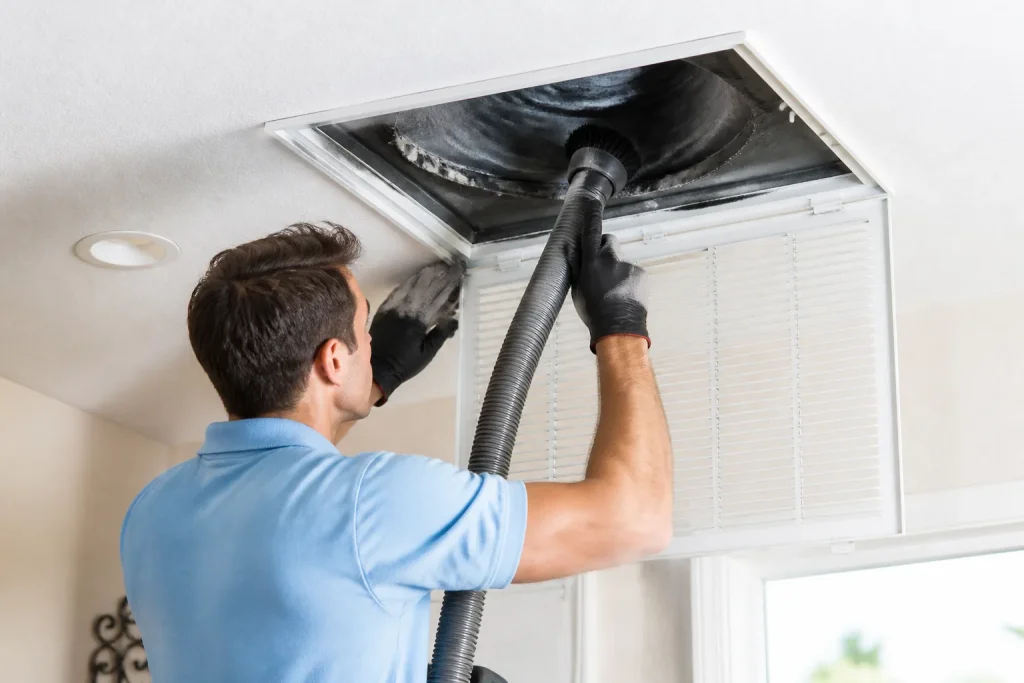
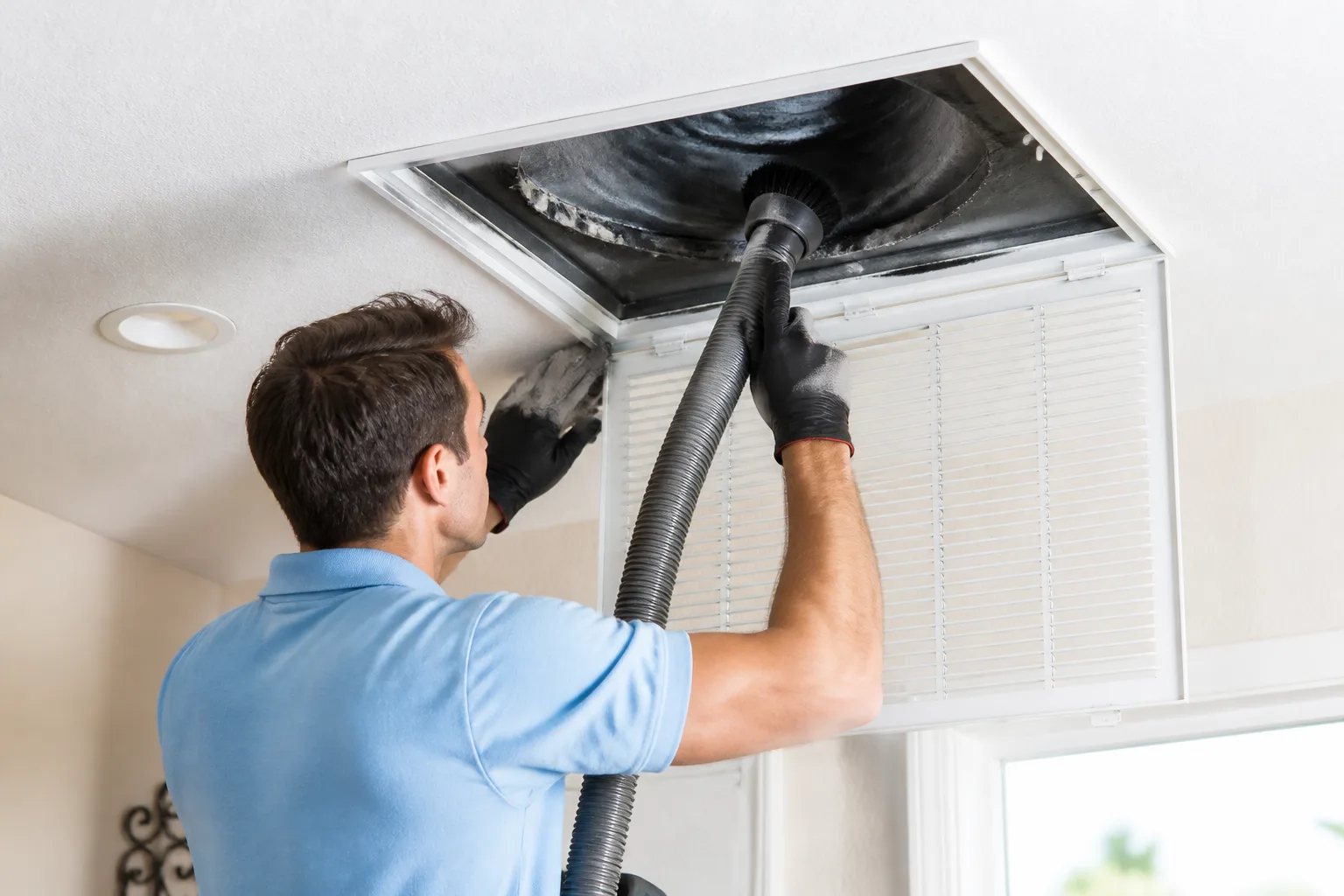
What needs a professional: Any evaluation of the interior duct surface requires access equipment and either a borescope camera or physical access to the duct runs. Brushing and extraction requires professional-grade tools, specifically rotary brush systems like Rotobrush paired with negative-pressure Nikro HEPA vacuums. This combination loosens adhered debris and captures it at the collection point rather than redistributing it through your home. Negative-pressure extraction means the loosened debris goes straight into the vacuum, not back into your living room.
One note on safety: if you have a gas furnace, the combustion chamber and heat exchanger are not DIY inspection areas for anyone without proper training. If you smell anything that resembles sulfur or gas during the first heater run, turn the system off and call a professional immediately.
How to Prep Your Home the Day of Duct Cleaning
Most Los Angeles homeowners have never had their ducts cleaned before, and the prep logistics are rarely explained. A little preparation makes the job faster and protects your home. Here’s the day-of checklist we give every customer:
- Clear a path to the furnace or air handler. The technician needs full access to the blower cabinet. That means a three-foot working radius around the unit. If your furnace is in a hallway closet, clear the hallway. If it’s in the garage, move bikes and storage bins away from the unit.
- Clear furniture around supply registers. Every supply register in the home gets accessed. That means floor registers under beds and sofas need clearance, and wall registers need nothing leaning against them. Technicians can’t move your furniture for liability reasons, so handle this before arrival.
- Secure pets in a separate room or with a sitter. The front door will open and close repeatedly, hoses will run through the house, and air hoses make unfamiliar noises. A stressed animal can slip out an open door or interfere with equipment. A closed room with water and a familiar bed is sufficient.
- Make windows available for access if needed. Some duct layouts require a hose to run through a window to the truck. If the technician asks, be prepared to open one or two windows. This is standard for portable extraction units.
- Know where your main return is. It’s often a large grille in a hallway, typically near the thermostat. It may be behind a door that needs to stay open during cleaning.
The entire process for a typical single-family home in Los Angeles takes between two and four hours depending on system size and number of registers. You don’t need to leave the house. You can work from home, watch the process, and ask questions as the technician works.
Post-Cleaning Winter Maintenance: Keeping the Clean Baseline
A freshly cleaned duct system is the starting point, not the finish line. What you do in the months after cleaning determines whether the system stays clean through the heating season. Here’s how to extend the benefit of your fall duct cleaning through winter.
Start with filtration. The standard one-inch fiberglass filters sold at hardware stores are designed to protect the equipment, not your air quality. They catch large debris and let fine particulate pass through. After a professional cleaning, consider upgrading to a higher-performance media filter. Aprilaire whole-home media filters are installed at the air handler and provide substantially better particulate capture without restricting airflow the way many high-MERV one-inch filters do. A Honeywell option is also worth comparing depending on your system configuration. The key is matching the filter to your blower’s static pressure capacity; too high a MERV rating on a one-inch filter can reduce airflow and strain the blower motor.
During heating season, check your filter monthly. Los Angeles air is dust-heavy even in winter, and the same particulate that makes our sunsets dramatic loads filters quickly. Set a phone reminder. It takes sixty seconds.
If anyone in the home has meaningful allergies or respiratory sensitivity, consider UV air purification at the coil. UV systems placed at the evaporator coil reduce biological growth on the coil surface, which is a common LA issue given our mild winters and the moisture that condenses during cooling cycles that still happen on warm winter days. This is a professional installation task, not a DIY project; the UV lamp placement and electrical connection require a trained tech.
Finally, schedule a quick visual inspection of the system in early spring if you plan to prepare for cooling season the way you did for heating season. The cycle repeats, but a maintained system stays cleaner longer each season.
When to Call a Pro
You can do the pre-winter checklist yourself, but the actual cleaning requires commercial equipment and trained operators. The job involves loosening adhered debris with rotary brushes and extracting it with HEPA-filtered negative-pressure vacuums, not pushing a shop-vac hose into a register and hoping for the best. We run Rotobrush rotary brush systems paired with Nikro HEPA extraction vacuums for exactly this reason. The brush agitates material that has adhered to duct walls over months of dry-season deposition; the vacuum captures it at the source.
If your first heater run produced a noticeable odor, if you saw dark streaking around registers, or if anyone in the home has allergy symptoms that worsen when the heat runs, the system needs professional attention before you spend a season heating that air.
If duct work isn’t your only concern, we also provide dryer vent cleaning in Los Angeles, which addresses a separate but related fire safety issue, and HVAC cleaning in Los Angeles for full system treatment including blower and coil. Our Cardinal Air Duct Cleaning home service area covers the full Los Angeles basin.
The Bottom Line
Los Angeles winters are mild, but they bring the first sustained heater use since the previous heating season ended, and that means six months of accumulated wildfire particulate, pest debris, and dry-season dust moves through your home on day one of cold weather. Fall is the right time to clean, not spring. Do the pre-winter checklist yourself: check your filter, inspect register faces, run the heater early to test for odor, and look at any exposed ductwork. Leave the interior cleaning to a professional with proper equipment. After cleaning, upgrade your filtration and check the filter monthly through winter.
If you’re in Los Angeles and want help this season, Cardinal Air Duct Cleaning offers free estimates and a written price before any work starts. Call (737) 727-2314.
Frequently Asked Questions
Most standard air duct cleanings for a typical single-family home in Los Angeles run between $450 and $850 depending on the number of registers, system size, and accessibility. Homes with multiple systems, long duct runs, or significant contamination may run higher. We give a written price before any work starts, and that price does not change at the door. Call (737) 727-2314 for an exact quote, and we can provide a phone estimate that holds.
In Los Angeles, every three to five years is a reasonable interval for most homes, but that depends heavily on wildfire seasons, whether you have pets, and whether anyone in the home has respiratory sensitivity. Homes near major fire zones or with significant pest activity may need cleaning more frequently. The best signal is the condition of your registers and filters: if you see dark streaking around registers or your filters are gray within a month of replacing, the system is carrying more particulate than it should.
You can clean the register covers and visible surfaces yourself, but interior duct surfaces cannot be properly cleaned with household tools. A shop-vac inserted into a register reaches only the first few feet of the duct and does not agitate adhered material. Professional cleaning uses rotary brushes to dislodge material and HEPA-filtered negative-pressure vacuums to capture it. Without both, you’re knocking debris loose and leaving it in the system. Call (737) 727-2314 for a professional estimate.
The duct cleaning industry has a documented bait-and-switch problem, particularly in large markets like Los Angeles. A low per-vent price gets a technician into the home, then the scope expands once the system is opened. What we quote is a whole-system price based on the characteristics of your home, and it’s handed to you in writing before any work begins. If a quote seems too low to cover equipment, labor, and insurance, it probably is. The correct comparison is not per-vent price; it’s total price for a defined scope of work, plus whether before-and-after photo documentation is included.
The standard we hold is photographic proof. Every Cardinal Air Duct Cleaning job includes before-and-after photos of the interior duct surfaces, not just a receipt. That’s part of The Relay Standard booking experience: a live trackable arrival time, before-and-after photo documentation, and a digital invoice you can pay from a link. If a duct cleaning company cannot show you the inside of your ducts before and after, you have no way to verify the work. Call (737) 727-2314 and ask about our documentation standards.
Written by the team at Cardinal Air Duct Cleaning.
Need Air Duct Cleaning Help?
Call Cardinal Air Duct Cleaning - licensed & insured, here with fast after-hours help in Los Angeles.
(737) 727-2314