
Top Signs You Need Air Duct Cleaning Service – Don’t Ignore These
The clearest signs you need air duct cleaning in Los Angeles are visible dust buildup around your supply vents, a musty smell when the HVAC kicks on, unexplained spikes in your energy bill, and allergy symptoms that worsen indoors. But here’s the part most homeowners get wrong: a dusty living room usually means leaky ducts or a failing filter, not dirty ducts. Timing-based advice like “clean every three years” ignores what’s actually happening inside your system. If you’ve noticed any of the symptoms below and would rather not chase them down yourself, call (737) 727-2314 for a straight answer.
Let’s be honest about something up front: the duct cleaning industry has earned its skepticism. Too many companies sell cleanings on a calendar schedule because that’s how they keep technicians moving, not because your ducts actually need it. At Cardinal Air Duct Cleaning, we’d rather tell you the truth: you don’t need a cleaning because time passed. You need one because your home is showing you specific, observable symptoms. And some of the symptoms people attribute to dirty ducts are actually coming from a different problem entirely.
Key Takeaways
- Visible dust on furniture does not automatically mean dirty ducts. It often points to leaky ductwork or a clogged filter.
- The four reliable triggers are: vent film buildup, airflow changes, a musty HVAC smell, and a cooling bill that climbs without explanation.
- In Los Angeles, wildfire smoke, renovation dust, and Santa Ana winds create seasonal duct-loading events that make symptom watching more important than calendar watching.
- A 10-minute vent inspection with your phone camera can tell you more than a guess based on years since the last cleaning.
- If you do clean, insist on before-and-after photos. If a company won’t provide them, ask why.
The Signal Most Homeowners Misread: Dust on Furniture
You wipe down the coffee table on Tuesday and by Friday there’s a visible film again. That’s frustrating, and the first instinct is to blame the ducts. Here’s what we’ve learned from thousands of Los Angeles homes: freely floating dust that settles on horizontal surfaces is usually not coming from inside a sealed duct system. It’s coming from a leak.
Think about how a forced-air system works. Your HVAC pulls air through a filter, conditions it, and pushes it through supply ducts into your rooms. If those ducts were sealed and simply dirty inside, the dust would mostly stay put. It’s when ducts develop gaps or disconnections, often in attics or crawl spaces, that outside air gets pulled in. That outside air carries insulation fibers, attic dust, and whatever else is floating around. The result is dust raining from your vents.
So what’s the actual fix for a leaky duct system? Duct sealing, not necessarily duct cleaning. We’ve done leak repairs where the homeowner had already paid for two cleanings and the dust returned within weeks both times. The cleaning wasn’t the problem. The leaking was. That’s why the first step is always diagnosis, not equipment.
The Four Symptoms That Actually Point to Dirty Ducts
So if furniture dust is a red herring half the time, what are the real signals that your ducts themselves are loaded with debris? In our experience, there are four that hold up under scrutiny.
1. Visible film or debris at the supply vents
Remove a supply vent cover, the one that blows air out, and look at the inside walls of the duct opening with your phone’s flashlight. You’re looking for gray or brown film clinging to the metal, clumps of dust, or what looks like lint. If you see a fuzzy coating, that’s what’s been passing into your air every time the system runs. This is the single most reliable visual indicator that a cleaning would help.
2. The “wet sock” smell when the system starts
If the air coming from your vents smells stale or musty for the first few seconds after the system kicks on, you may have microbial growth inside the ductwork or evaporator coil. This is a specific smell. It’s not the smell of dust. It’s damp, earthy, and persistent. In Los Angeles, where humidity varies wildly between coastal and inland neighborhoods, condensate on coils creates the exact conditions where this problem develops. Cleaning removes the organic material; a filter change alone won’t touch it.
3. Airflow from the vents feels weak or uneven
Some rooms cool down fast. Others never quite get there. If you hold a tissue near a vent in one room and it flutters, then hold it near a vent in another and it barely moves, you’re looking at a restriction. Duct buildup is one cause, especially in older Los Angeles homes with original ductwork. Another cause is a collapsed or kinked flex duct. Either way, reduced airflow means your system runs longer to reach the same temperature.
4. Your SoCal Edison bill climbs during HVAC season
Restricted airflow forces your AC to work harder, and in Los Angeles, where summer cooling loads are brutal, that translates directly to dollars. We’ve had customers call about a $100 or $150 monthly jump on their bill. They assumed the utility had raised rates. In several cases, the real story was an HVAC system struggling against severely restricted ducts. A cleaning or airflow correction brought the bill back to baseline. If your bill went up without a matching change in how you use the system, restricted airflow is worth investigating.
Los Angeles-Specific Triggers That Most National Articles Miss
Generic articles written for a national audience don’t account for what it’s like to live in Los Angeles. Our air is different, our fire season is different, and our weather patterns are different. If you live in Burbank, Sherman Oaks, Pasadena, or anywhere near the foothills, these triggers matter more than any calendar schedule.
Post-wildfire smoke infiltration. Wildfire smoke brings fine particulate matter that doesn’t just drift through open windows. It gets pulled into your HVAC system, settles in the blower, and embeds in the ductwork. Even after the outdoor air clears, the system can continue recirculating smoky residue. If you ran your AC during a major wildfire event, especially the 2020 Bobcat Fire or the 2025 Palisades and Eaton fires, the inside of your ducts may hold more than you’d expect.
Post-renovation drywall dust. Los Angeles is a city that never stops remodeling. If you’ve had any kind of drywall work, flooring, sanding, or demo done in your home, that ultra-fine dust gets everywhere, including inside your ducts through return vents. Drywall dust is abrasive and clings to everything. It doesn’t just blow through; it settles and accumulates. One renovation without protected vents is enough to justify a cleaning.
Santa Ana wind events. Those dry, gusty winds push dust and fine particulate through open windows, door gaps, and any unsealed point in your home’s envelope. Santa Ana events spike indoor particulates across the region. If your system’s filter isn’t catching them, they end up in the ducts.
None of these are on a “3-to-5-year” schedule. They happen when they happen. The only way to know is to look.
The 10-Minute Vent Inspection You Can Do with Your Phone
We don’t think you should need a technician to tell you whether your ducts look loaded. Most of the time, a quick DIY inspection gives you the answer. Here’s a simple process that takes about 10 minutes in a typical Los Angeles home.
Step 1: Grab a Phillips screwdriver. Most supply vent covers come off with a few screws. If it’s a ceiling vent, use your free hand to hold the cover so it doesn’t drop.
Step 2: Use your phone’s flashlight to look inside. Point the light into the duct opening. You’re looking for a visible dust film, debris clumps, or discoloration on the metal.
Step 3: Take a photo with your camera, flash on. This gives you a record. It also forces you to actually look at the image rather than squinting into the dark.
Step 4: Wipe a spot with a damp white paper towel. Press it against the duct wall. If it comes back gray or black, that’s accumulated particles, not surface dust.
Step 5: Repeat at two or three vents. Duct buildup is rarely uniform, but checking multiple vents tells you whether it’s isolated or system-wide. If it’s isolated, the problem might be a leak at a specific connection rather than dirty ducts throughout.
Here’s what you’re not looking for: sawdust-sized wood chips, loose insulation fragments, or visible gaps where the duct meets the boot. Those point to construction debris or leaks, which are separate problems requiring different fixes. If you’re not sure what you’re seeing, send us the photo. We’d rather tell you what it means over the phone than sell you a cleaning you don’t need.
We pulled a dryer vent line out of a laundry room over in Studio City last month that had a lint and dust wad the size of a throw pillow. The homeowner had never thought to look. It backed right into the HVAC return. Sometimes what’s in the duct is worse than you think.
What Before-and-After Photos from a Rotobrush Cleaning Actually Reveal
One of the things we insist on, at every job, is photo documentation. Not as a sales tactic. As a record. Because if you’re paying for a cleaning, you should be able to see exactly what was removed, exactly what the duct looked like when we arrived, and exactly what it looked like when we packed up.
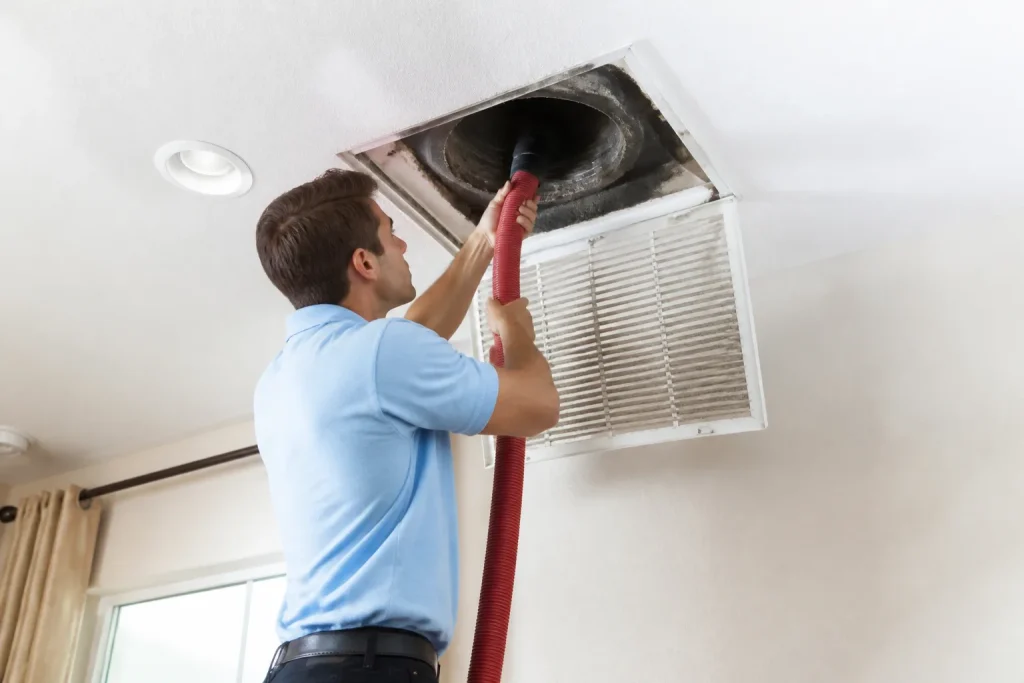
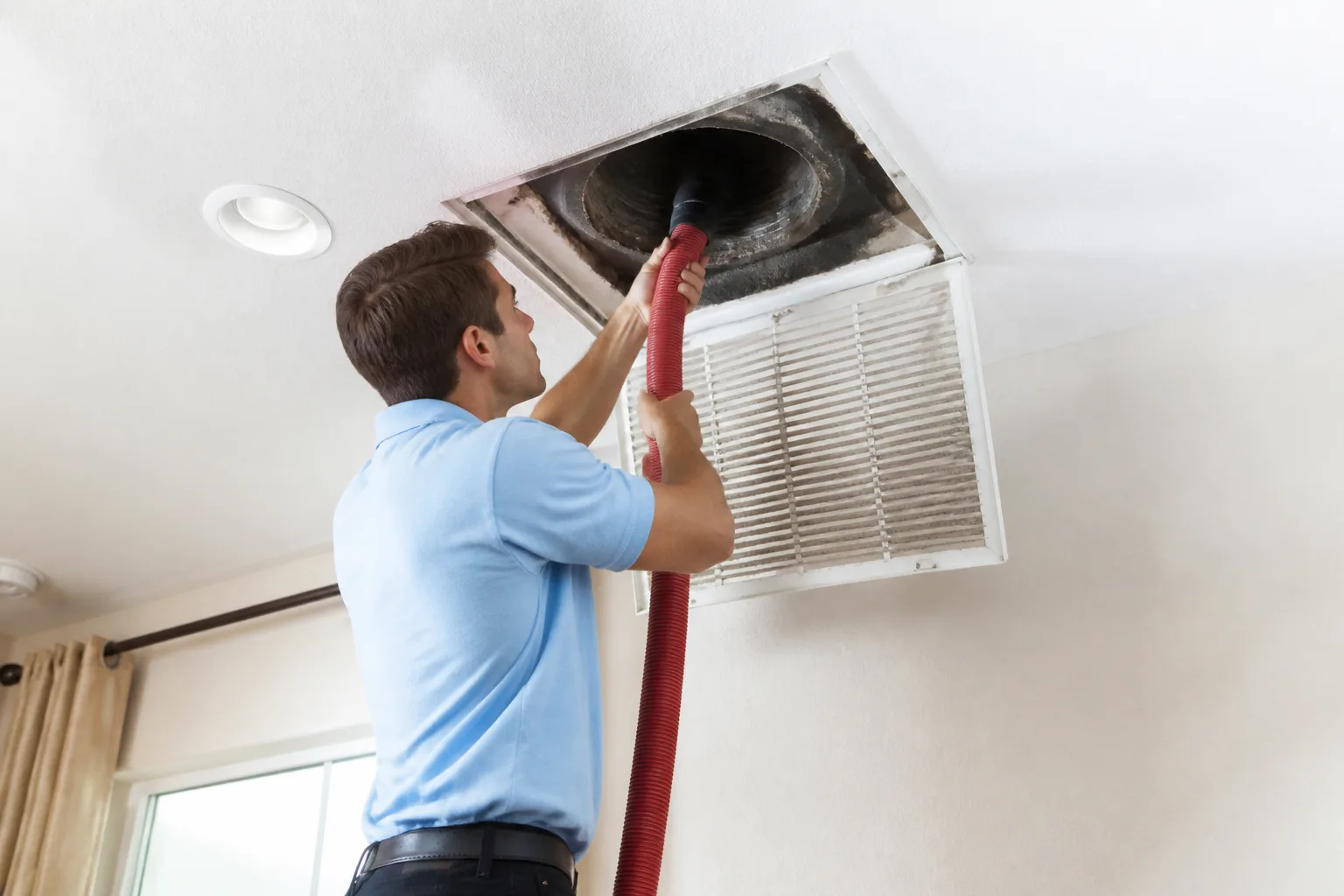
When a Rotobrush rotary brush system runs through a duct, it physically agitates the walls, breaking loose dust film and debris that has adhered over years. The material is then pulled out under negative pressure by a HEPA-filtered vacuum, a Nikro or Abatement Technologies unit depending on the job. Negative-pressure extraction means the loosened debris travels straight into the vacuum’s sealed containment system, not back into the breathing air of your living room. That’s the distinction between professional-grade equipment and a truck-mounted shop-vac shortcut.
The before photos from our jobs frequently show a wall of gray-brown coating that looks like felt. The after photos show clean metal, the color of galvanized steel. If you can’t see the seam lines on the inside of a metal duct after a cleaning, the job wasn’t finished. That’s the standard we hold ourselves to, and it’s the standard you should hold anyone to.
We provide those photos to every customer through the Relay Standard booking experience. You get a live trackable arrival time before the technician shows up, photo documentation of the work as it happens, and a digital invoice you can pay from a link on your phone. No waiting to see what happened. No wondering who’s coming. And if the photos show the work wasn’t done to the standard we promised, the Done Right Promise means we come back and fix it. No charge, no argument.
Dirty Ducts vs. Leaky Ducts vs. a Failing Filter: Why Getting This Wrong Costs You
This is where we see Los Angeles homeowners spend real money on the wrong service. All three problems can produce similar symptoms: excess dust, weak airflow, higher bills. But the fixes are completely different.
Dirty ducts collect particulate over years. The fix is professional cleaning with agitation and extraction. A cleaning addresses the accumulated debris.
Leaky ducts pull in outside air through gaps and disconnections. The fix is duct sealing or repair, not cleaning. In fact, cleaning a leaky duct system without sealing it first can leave you right back where you started within months.
A failing filter lets particles pass right through to the blower and evaporator coil. The fix is a new filter, potentially a higher-MERV option from a brand like Honeywell or Aprilaire depending on your system and your household’s air quality needs in Los Angeles. In some cases, a Guardsman filter upgrade is the right call. The point is: changing a filter takes five minutes and costs under $30. Cleaning an entire duct system costs more. You don’t want to buy the expensive fix when the cheap one was what you needed.
How do you tell the difference? The vent inspection above is the most reliable home method. But when you need certainty, a professional inspection with a camera scope gives you a definitive answer. We’ve told more than a few callers that they didn’t need a cleaning. Sometimes the honest diagnosis is a $5 filter swap. Ours is included in a free estimate, which means you get a real answer, not a sales script.
When to Call a Pro in Los Angeles
If you’ve done the vent inspection and found significant buildup, or if you’ve noticed the musty smell, uneven airflow, or a suspicious bill spike, it’s time for a professional assessment. You don’t need to have all the answers. You need a clear diagnosis and a written price before any work begins.
At Cardinal Air Duct Cleaning, that’s how we operate. Every job starts with an inspection and a written quote. The price doesn’t change at the door. The technician who shows up is background-checked, uniformed, and goes by name before the appointment, because you should know who’s coming into your home. The quote includes the specific scope: what gets cleaned, what equipment we’re using, and whether we’ve identified leaks, filter issues, or anything else that affects the work.
Related services in Los Angeles: Air Duct Cleaning in Los Angeles, HVAC Cleaning in Los Angeles, and Dryer Vent Cleaning in Los Angeles. Each service has its own page with pricing ranges and what to expect, if you’re comparing options.
The Bottom Line
Stop measuring duct cleaning in years and start measuring it in symptoms. The calendar doesn’t tell you what’s inside your ducts. The vents do. Look at them. Wipe them. Photograph them. If the evidence points to buildup, get a professional cleaning with real equipment and before-and-after proof. If the evidence points elsewhere, fix the right problem and don’t overpay for the wrong service.
In Los Angeles, the triggers are seasonal and specific: wildfire smoke, renovation dust, Santa Ana winds, summer cooling loads. Pay attention to what your system is showing you, not what a marketing calendar says you’re due for. If you’re in Los Angeles and need a real diagnosis, Cardinal Air Duct Cleaning offers free estimates. Call (737) 727-2314 and we’ll tell you what’s actually going on, with a written price before any work begins.
Frequently Asked Questions
The most obvious signs are visible dust film inside your supply vents, a stale or musty smell when the system starts, significantly weaker airflow in some rooms, and a cooling bill that climbs during summer without a change in usage. In Los Angeles, post-wildfire smoke, renovation dust, and Santa Ana wind events can cause sudden duct buildup even if the system was cleaned recently. If you notice any of these, remove a vent cover and look inside with a phone flashlight. If you see a fuzzy gray or brown coating, schedule an inspection. Call (737) 727-2314 for a free estimate.
Dust settling on furniture is usually caused by leaky ducts pulling in attic or crawl space air, or by an underperforming filter. Dust caked inside the duct itself, visible when you remove a vent cover, is the real indicator of dirty ducts. The simplest test is the white paper towel wipe: press it against the duct wall and see if it comes away gray. If the dust is on your furniture but the duct walls look clean, investigate duct leaks and your filter first. We help Los Angeles homeowners make this distinction every week during free estimates.
Yes, and it’s more common in Los Angeles than most people realize. When dust and debris restrict airflow, your AC system runs longer and harder to hit the thermostat setting. On a hot San Fernando Valley summer, that extra runtime compounds quickly. A professional cleaning restores proper airflow, which can return the bill to its previous baseline. If your SoCal Edison bill rose unexpectedly during cooling season and your usage habits haven’t changed, restricted airflow from duct buildup is worth checking. Call (737) 727-2314 and we’ll help you figure out if it’s a duct problem or something else.
There’s no honest answer for every home because the right timing depends on exposure events, not calendar years. A home near recent wildfire smoke, a home that just underwent renovation, and a pet-free home with a strong filter will all have very different needs. Some Los Angeles homes genuinely need a cleaning every two years. Others can go eight or ten without a problem. The vent inspection, not a schedule, is the only reliable guide. If you do schedule a cleaning, make sure the company provides before-and-after photos of their own work. The Cardinal Air Duct Cleaning home page explains how we document every job.
Written by the team at Cardinal Air Duct Cleaning.
Need Air Duct Cleaning Help?
Call Cardinal Air Duct Cleaning - licensed & insured, here with fast after-hours help in Los Angeles.
(737) 727-2314